
Ever tried to name a flower that starts with W and drawn a blank after wisteria? You’re not alone. Most people stall at two or three.
The good news: flowers that start with W cover woodland carpets, pond stars, winter bloomers, and even a national-emblem showstopper. Here are 50 of them, sorted so you can actually use the list.
Quick Answer: What Are Flowers That Start With W?
Flowers starting with W include wisteria, wallflower, waratah, water lily, witch hazel, and wild bergamot. They range from tiny wildflowers to big climbing flowering vines.
Some bloom in winter, others in summer. You’ll find white flowers, yellow flowers, and plenty of purple flowers in the mix.
Flower Names Starting With W: At A Glance
Here’s a snapshot before we go deep. It shows how wide the range really is.
| Group | Examples |
| Flowering vines | Wisteria, Wreath Flower |
| Flowering shrubs | Weigela, Witch Hazel, Wintersweet |
| Aquatic flowers | Water Lily, Water Lotus, Water Violet |
| Woodland flowers | Wood Anemone, White Trillium, Wake Robin |
| Wildflowers | Wild Bergamot, Wild Columbine, Wild Geranium |
Complete List Of 50 Flowers Starting With Letter W
This is the complete list of flowers starting with W we’ll cover. Each one gets a short profile later. Botanical names help with flower identification at the nursery.
| # | Common name | Botanical name |
| 1 | Wake Robin | Trillium erectum |
| 2 | Wallflower | Erysimum spp. |
| 3 | Wandflower | Dierama spp. |
| 4 | Waratah | Telopea spp. |
| 5 | Water Avens | Geum rivale |
| 6 | Water Hyacinth | Pontederia crassipes |
| 7 | Water Iris | Iris laevigata |
| 8 | Water Lily | Nymphaea spp. |
| 9 | Water Lotus | Nelumbo nucifera |
| 10 | Water Violet | Hottonia palustris |
| 11 | Watsonia | Watsonia spp. |
| 12 | Wax Begonia | Begonia × semperflorens-cultorum |
| 13 | Waxflower | Chamelaucium uncinatum |
| 14 | Wedelia | Sphagneticola trilobata |
| 15 | Weigela | Weigela spp. |
| 16 | Western Red Lily | Lilium philadelphicum |
| 17 | Western Wallflower | Erysimum capitatum |
| 18 | Whirling Butterflies | Oenothera lindheimeri |
| 19 | White Campion | Silene latifolia |
| 20 | White Snakeroot | Ageratina altissima |
| 21 | White Trillium | Trillium grandiflorum |
| 22 | White Wood Aster | Eurybia divaricata |
| 23 | Wild Bergamot | Monarda fistulosa |
| 24 | Wild Columbine | Aquilegia canadensis |
| 25 | Wild Geranium | Geranium maculatum |
| 26 | Wild Indigo | Baptisia spp. |
| 27 | Wild Petunia | Ruellia humilis |
| 28 | Wild Phlox | Phlox divaricata |
| 29 | Wild Rose | Rosa spp. |
| 30 | Wild Senna | Senna hebecarpa |
| 31 | Wild Sunflower | Helianthus spp. |
| 32 | Willowherb | Epilobium spp. |
| 33 | Windflower | Anemone spp. |
| 34 | Wine Cup | Callirhoe involucrata |
| 35 | Winged Monkey Flower | Mimulus alatus |
| 36 | Winter Aconite | Eranthis hyemalis |
| 37 | Winter Jasmine | Jasminum nudiflorum |
| 38 | Wintersweet | Chimonanthus praecox |
| 39 | Wishbone Flower | Torenia fournieri |
| 40 | Wisteria | Wisteria spp. |
| 41 | Witch Hazel | Hamamelis spp. |
| 42 | Woadwaxen | Genista tinctoria |
| 43 | Wood Anemone | Anemonoides nemorosa |
| 44 | Wood Sorrel | Oxalis acetosella |
| 45 | Wood Violet | Viola odorata |
| 46 | Woodland Sunflower | Helianthus divaricatus |
| 47 | Woodruff | Galium odoratum |
| 48 | Woolly Yarrow | Achillea tomentosa |
| 49 | Wreath Flower | Stephanotis floribunda |
| 50 | Waling Waling | Vanda sanderiana |
Popular Flower Names Starting With W
Wisteria, water lily, and wallflower top most searches. They show up in postcards, ponds, and cottage walls.
Weigela and witch hazel round out the popular flower names starting with W. Both are easy to find at a garden center.
Common Flowers That Start With W
Common flowers that start with W are the ones you’ll actually spot on a walk. Think wild rose, white campion, and willowherb.
They grow across meadows and roadsides. Many are native wildflowers, so they feed local wildlife too.
Rare Flowers That Start With W
Waling waling is the star here. This orchid from the Philippines is prized, and its wild populations are under pressure.
Waratah and wintersweet are uncommon flowers too. You’ll rarely see them outside specialist nurseries or warm climates.
Types Of Flowers That Start With W
The types of flowers that start with W split neatly by habit. Some are herbaceous perennials, some are bedding plants, and some are woody.
Others float on water. That variety is why this letter is so fun for flower varieties hunting.
Plants Vs Flowers That Start With W
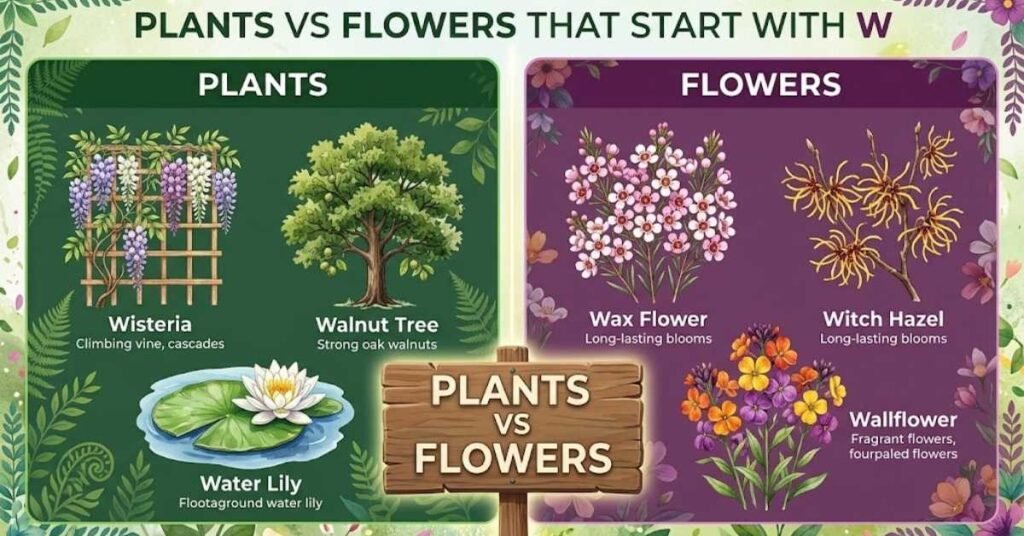
Here’s a trap: not every W plant is mainly grown for blooms. Woodruff is loved for foliage, while wisteria is a vine first.
We included each one because its flowers are a real selling point. That’s our flower-first classification.
Perennials That Start With W
Perennials that start with W return every year. Wild bergamot, wild geranium, wild indigo, and woolly yarrow are reliable picks.
Water lily and wandflower count too. Once settled, these give you long-lived garden plants with reduced replanting needs.
Annual Flowers That Start With W
Annuals finish their life cycle in one season. Wishbone flower and wax begonia are classic annual bedding flowers.
Note that wax begonia acts as a perennial in frost-free spots. Climate-dependent annuals like this vary by region.
Purple Flowers That Start With W
Want purple flowers that start with W? Wisteria leads, followed by wild phlox, wild petunia, and winged monkey flower.
Water iris and water violet add lavender flowers to the pond edge. Wishbone flower brings a violet punch to containers.
Wildflowers That Begin With The Letter W
Wildflowers that start with W are the heart of this list. Wild columbine, wild bergamot, and white wood aster feel effortless.
Plant them in meadow-style planting and let them self-seed. Check local planting rules first, though.
Aquatic And Wetland Flowers That Begin With The W
Water lily and water lotus are the floating aquatic plants everyone pictures. Water violet and water iris prefer shallow water and pond edges.
Be careful with water hyacinth. It’s an invasive aquatic plant in many places, so regional planting restrictions apply.
Woodland And Shade Friendly W Flowers
Wood anemone, white trillium, and wake robin carpet the forest floor in spring. They love humus-rich soil and even soil moisture.
Woodruff and wood sorrel handle full shade well. Together they make a calm, naturalized shade bed.
Shrubs, Vines, And Structural Bloomers
Weigela, witch hazel, and wintersweet give your garden bones. Wisteria and wreath flower climb pergolas and trellises.
Wisteria is a woody climbing vine that needs strong support. Prune it yearly or it’ll take over.
Best W Flowers By Color
Pick by color first, and the garden plan gets easier. This is a quick flower color chart.
- White: White Trillium, Wood Anemone, White Campion, Woodruff, Wreath Flower
- Yellow: Winter Aconite, Winter Jasmine, Wild Senna, Woolly Yarrow, Woadwaxen
- Pink and magenta: Weigela, Wine Cup, Wild Geranium, Willowherb
- Purple and blue: Wisteria, Wild Phlox, Water Iris, Wishbone Flower
- Red and orange: Waratah, Western Red Lily, Wild Columbine
Best W Flowers By Bloom Season
Timing matters more than most gardeners admit. Match bloom time and you’ll have color from February to frost.
- Winter and early spring: Winter Aconite, Wintersweet, Witch Hazel, Winter Jasmine
- Spring: Wisteria, Wood Anemone, White Trillium, Wild Phlox, Weigela
- Summer: Water Lily, Wild Bergamot, Wine Cup, Whirling Butterflies
- Late season: White Wood Aster, White Snakeroot, Wild Sunflower
Best Picks For Different Garden Uses
Different jobs need different plants. Here’s how to match them to your space.
- Pollinator gardens: Wild Bergamot, Wild Columbine, Wild Indigo
- Containers and hanging baskets: Wishbone Flower, Wax Begonia
- Pond displays: Water Lily, Water Iris, Water Lotus
- Cut flower arrangements: Waxflower, Wild Indigo spikes, Weigela stems
- Shade beds: Wood Anemone, Woodruff, Wood Sorrel
Quick Comparison
This flower comparison table helps you choose fast. It covers eight favorites.
| Flower | Type | Light | Moisture | Best use |
| Wisteria | Vine | Full sun | Moderate | Pergolas |
| Water Lily | Aquatic perennial | Full sun | Still water | Ponds |
| Wild Bergamot | Perennial | Full sun | Moderate | Pollinator beds |
| Wood Anemone | Perennial | Shade | Moist | Woodland gardens |
| Weigela | Shrub | Sun to part shade | Moderate | Borders |
| Wishbone Flower | Annual | Part shade | Even | Containers |
| Wine Cup | Perennial | Full sun | Dry to average | Sunny edges |
| Witch Hazel | Shrub | Sun to part shade | Moderate | Winter interest |
Visual Identification Tips
Start with flower shape identification. Wisteria hangs in drooping flower clusters, while wild columbine has nodding, spurred blooms.
Next, check leaves. Wood sorrel has clover-like leaves, and wandflower shows sword-like foliage with arching flower stems.
Short Descriptions For All 50 Flowers
Use these quick profiles to confirm a name or spark an idea. Details can shift by region, so check your local garden growing zones.
- Wake Robin: Maroon, three-petaled blooms that open in spring woodlands.
- Wallflower: Fragrant, colorful spikes that suit sunny walls and dry borders.
- Wandflower: Arching stems with pendant pink bells above grassy leaves.
- Waratah: Bold red Australian bloom heads that act as true focal-point flowers.
- Water Avens: Nodding pink and orange bells for damp ground.
- Water Hyacinth: Floating purple spikes, but invasive in many warm regions.
- Water Iris: Blue-violet flowers for pond margins and wet soil.
- Water Lily: Floating cups sitting on broad round pads.
- Water Lotus: Upright pink or white blooms above big, round leaves.
- Water Violet: Pale lilac whorls rising from a submerged plant.
- Watsonia: Corm-grown spikes in pink or orange for sunny beds.
- Wax Begonia: Glossy leaves and nonstop small blooms for bedding.
- Waxflower: Waxy pink or white blossoms, popular in bouquets.
- Wedelia: Yellow daisy-like flowers on a spreading groundcover; it can turn invasive.
- Weigela: Spring shrub with trumpet-shaped pink flowers.
- Western Red Lily: Upright orange-red cups with spotted throats.
- Western Wallflower: Orange to yellow clusters on a tough, dry-site native.
- Whirling Butterflies: Airy white to pink flowers that flutter on thin stems.
- White Campion: Simple white blooms that open mostly in the evening.
- White Snakeroot: Fluffy white heads in late summer, but toxic to livestock.
- White Trillium: Three large white petals, a spring woodland icon.
- White Wood Aster: Small white daisies that brighten shady fall borders.
- Wild Bergamot: Lavender, shaggy heads that pollinators adore.
- Wild Columbine: Red and yellow nodding flowers that hummingbirds visit.
- Wild Geranium: Pink-lavender open blooms over lobed leaves in spring.
- Wild Indigo: Tall spikes in blue, white, or yellow, depending on species.
- Wild Petunia: Lavender trumpets on a low, sun-loving native.
- Wild Phlox: Fragrant blue-lavender clusters for spring shade.
- Wild Rose: Five-petaled pink blooms followed by bright hips.
- Wild Senna: Yellow summer flowers on a tall, bushy perennial.
- Wild Sunflower: Cheerful yellow rays that feed bees and finches.
- Willowherb: Pink to magenta spikes for moist or disturbed ground.
- Windflower: Delicate anemones that dance in even a light breeze.
- Wine Cup: Magenta cups on a trailing, drought-tolerant plant.
- Winged Monkey Flower: Lavender-blue flowers for wet meadows and stream banks.
- Winter Aconite: Golden cups that push through late-winter snow; all parts are toxic.
- Winter Jasmine: Yellow blooms on green arching stems in the cold months.
- Wintersweet: Waxy, sweetly scented flowers on bare winter branches.
- Wishbone Flower: Blue and violet blooms with a yellow throat for shady pots.
- Wisteria: Cascading purple clusters on a vigorous, twining vine.
- Witch Hazel: Ribbon-like petals that spark color in late fall or winter.
- Woadwaxen: Bright yellow pea-like flowers on a small shrubby plant.
- Wood Anemone: White star flowers carpeting spring woods.
- Wood Sorrel: White blooms veined with purple above clover-like leaves.
- Wood Violet: Small, sweet-scented violet flowers on a low, spreading plant.
- Woodland Sunflower: Yellow daisies for partly shady, dry spots.
- Woodruff: Tiny white stars and a fresh, hay-like scent.
- Woolly Yarrow: Gray-green mat with flat yellow flower heads.
- Wreath Flower: Waxy white, richly scented blooms on a twining vine.
- Waling Waling: Large, showy orchid blooms from the Philippines, a collector’s prize.
How This Flower List Was Built
We picked names people actually search for and use. Each flower has a recognized common name and a botanical name for clean flower identification.
We also balanced habitats and bloom seasons. Some common names overlap between regions, so always confirm the botanical name before buying.
Growing Tips Before You Plant
Check your hardiness zone first. Plant hardiness decides more outcomes than any fertilizer.
Then match light and moisture to the plant. A shade lover in full sun will struggle, no matter how well you water it.
Fragrance And Pollinator Perks
Wisteria, wintersweet, wallflower, and wreath flower bring sweet floral fragrance. Wild bergamot and wild columbine are nectar-producing flowers that feed pollinators.
Choosing natives supports biodiversity. It also means fewer headaches with pests and local weather.
Safety And Invasive Plant Notes
Some W plants are toxic if eaten. Winter aconite and white snakeroot are good examples, so keep them away from pets and livestock.
Water hyacinth and wedelia can spread aggressively. Ask your local extension office before planting them.
Conclusion
You now have 50 flowers that start with W, plus the context to pick the right one. Start with your light, soil, and season, then choose by color.
Which one surprised you most? Drop it in the comments, and share this list with a friend who loves gardening. We’ll keep it fresh as new picks come up.
FAQs
What Are The Most Popular Flowers That Start With W?
Wisteria, water lily, wallflower, weigela, and witch hazel are the most popular. Wild bergamot is a favorite among native plant fans.
How Many Flowers Start With W?
Hundreds do, depending on how you count common names. This guide covers a curated list of 50 well-known ones.
What Is The Most Common Flower That Starts With W?
Wisteria is the one most people name first. Wild rose is probably the most widespread in nature.
Are There Any Rare Flowers That Start With W?
Yes. Waling waling and waratah are rarely seen outside specialist collections or warm regions.
What Are Some Purple Flowers That Start With W?
Wisteria, wild phlox, wild petunia, wishbone flower, and winged monkey flower all bloom in purple shades.
Are There Any Perennials That Start With W?
Many. Wild bergamot, wild geranium, wine cup, wood anemone, and woolly yarrow all return yearly.
Are There Any Annual Flowers That Start With W?
Wishbone flower is a true bedding annual. Wax begonia is often grown as one in cold climates.
What Flowers Starting With W Grow In Water?
Water lily, water lotus, water iris, water violet, and water hyacinth all grow in water or very wet soil.
Is Wisteria A Flower Or A Vine?
Both. It’s a woody climbing vine that produces long, fragrant flower clusters in spring.
What Is The Best W Flower For Shade?
Wood anemone and woodruff are top picks. White trillium also thrives under tree cover.
Are There Any White Flowers That Start With W?
Yes. White trillium, wood anemone, white campion, woodruff, and wreath flower are all white.
Are There Any Yellow Flowers That Start With W?
Winter aconite, winter jasmine, wild senna, woolly yarrow, and woadwaxen all bloom yellow.
What W Flower Blooms In Winter?
Winter aconite, wintersweet, and winter jasmine bloom in the cold months. Witch hazel often flowers in late fall or winter.

Jack Danniel is a flower enthusiast, writer, and experienced SEO expert passionate about creating helpful content.
With years of experience in SEO and content strategy, he shares engaging and informative insights about flowers.
His goal is to make floral information easy to understand while helping readers discover the beauty of nature.