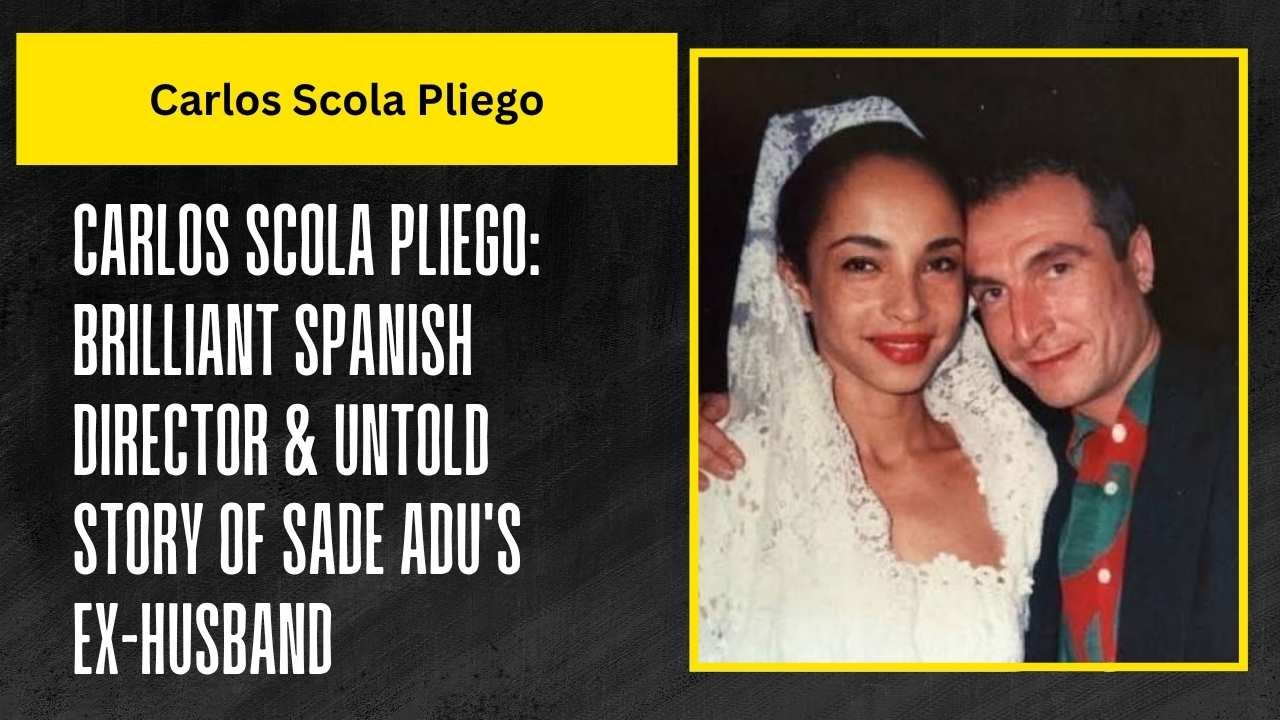
Carlos Scola Pliego is a Spanish film director, writer and assistant director who married British-Nigerian singer Sade Adu in 1989 and divorced her in 1995. Most people search his name because of that marriage. Yet his own record shows a working filmmaker with credits on international sets, two Spanish directing projects and a later football film.
Public information about him is limited. He gives no interviews and keeps no known social media presence. So this guide separates what is documented from what is rumor. You will get the verified timeline, the film credits, the marriage facts and an honest answer on the questions that other pages guess about
.Quick Facts Table
| Detail | Information |
| Full Name | Carlos Scola Pliego (often credited as Carlos Scola) |
| Nationality | Spanish |
| Profession | Assistant director, film director, writer |
| Birth Date and Place | Not publicly confirmed |
| Known For | Former husband of singer Sade Adu |
| Career Start | 1981 (second assistant director, Dos y dos, cinco) |
| Bond Connection | Second assistant director, Spain unit, Never Say Never Again (1983, uncredited) |
| Other International Credits | Curse of the Pink Panther (1983), Eleni (1985), Christopher Columbus (1985) |
| Directing and Writing Credits | Ngira: Gorilas en la montaña (1988), Donde termina el corazón (1989) |
| Latest Listed Credit | Goal II: Living the Dream (2007, additional crew) |
| Marriage to Sade Adu | 1989 (IMDb lists February 11; another site says October 11) |
| Divorce | 1995 |
| Length of Marriage | About 6 years |
| Children with Sade | None on public record |
| Net Worth | Not verified |
| Current Status | Lives privately in Spain, no known public profile |
Early Life, Background, and Spanish Roots
Carlos Scola Pliego is Spanish. That is the one background fact that every reliable source agrees on. His birth date, hometown and family details have never been published by trusted outlets.
Many websites invent a childhood story for him. Treat those pages with caution. A name that appears in film credit databases and in one singer’s official biography does not come with a public family history.
What we can say is simple:
- He was working in Spanish film by the early 1980s.
- He used the name Carlos Scola in most credits and Carlos Scola Pliego in some.
- He later settled into a private life in Spain.
Architectural and Creative Influences in Early Youth
Some pages claim he trained in architecture before film. No credible source confirms this. There is no school record, interview or biography that supports it.
Still, the claim makes some sense on the surface. An assistant director spends the day managing space, timing, crews and camera setups. That work rewards a strong visual and structural mind, the kind people often link with architecture.
So the safe reading is this: his creative influences are not documented, but his later work shows a clear eye for how a production is organized and how a scene is built.
Entering the Film Industry as an Assistant Director
Film databases place Carlos Scola Pliego on sets from 1981. His first listed credit is as a second assistant director on the Spanish film Dos y dos, cinco. In 1983 he appears as a third assistant director on Scarab.
An assistant director does not choose the story or the actors. The job is to keep the shoot on schedule, call the cast, manage extras and pass the director’s plan to the crew. It is a hard role and it builds discipline fast.
For a foreign production shooting in Spain, a local assistant director is also valuable. He knows the crew, the locations and the rules. That is likely why his name shows up on large international projects.
Major International Film Credits and James Bond Connection
His strongest credits come from big productions that filmed Spanish units in the 1980s. Here are the main ones listed in public film databases:
- Never Say Never Again (1983): second assistant director for the Spain unit, listed as uncredited.
- Curse of the Pink Panther (1983): second assistant director for Spain.
- Eleni (1985): assistant director for the Spanish crew, with John Malkovich in the cast.
- Christopher Columbus (1985 miniseries): assistant director for Spain.
The James Bond Link Explained
Never Say Never Again is the 1983 Sean Connery film that returned him to the role of James Bond. It was made outside the main Eon series, which makes it a unique entry in the franchise. Carlos Scola Pliego’s link to Bond is real but small. He was part of the Spain unit, and the credit is marked uncredited. Anyone who calls him a “Bond director” is stretching the facts.
Transition to Documentaries, Directing, and Screenwriting
By the late 1980s he moved from assisting to directing. Two projects mark that change:
- Ngira: Gorilas en la montaña (1988): a documentary about mountain gorillas.
- Donde termina el corazón (1989): a Spanish project on which he is credited as director and writer.
These credits matter for one reason. They show he was more than a husband to a famous singer. He had his own creative voice before and during his marriage. His directing years are short in the public record, but they are real.
Meeting Sade Adu: The Genesis of a High-Profile Romance
Sade Adu was already a global star by the mid-1980s. Her debut album Diamond Life (1984) and Promise (1985) had turned her into one of the most recognizable voices in pop and soul.
A 2024 profile in the Spanish newspaper El País reports that Carlos worked as an assistant director on three videos for the Promise era. That fits the most common account: the two met through film work in Spain. Sade’s official biography simply calls him a Spanish film director.
The exact first meeting, the date and the place have never been confirmed by either person. Be careful with any page that gives a detailed love story with quotes. Neither of them has shared one.
The Fairy-Tale Spanish Castle Wedding in 1989
Sade’s official biography confirms that she married Carlos Scola Pliego in 1989. IMDb lists the marriage date as February 11, 1989. One smaller website gives October 11, 1989. Because the sources disagree, the safest statement is “1989.”
You may also read that the wedding took place in a Spanish castle. That detail appears on a few lifestyle sites, but I could not find it in Sade’s official biography or in a major newspaper. It may be true, and it fits the romantic image. Yet it remains unverified.
What is clear is the tone. The couple kept the day private. There was no magazine spread and no televised event. That choice matches how both of them have lived since.
Life in Madrid: Balancing Fame, Music, and Art
After the wedding, Sade spent years in Spain. Many sources describe her life in the Madrid area during this period. The setting gave her distance from the London music press and a chance to live a quieter life.
For Carlos, Spain was home and the base of his film career. For Sade, it was a place to write, record and rest between albums. Her 1992 album Love Deluxe came out during the marriage years.
Two points worth keeping in mind:
- The couple avoided red carpets and gossip columns.
- Very few photos of them together exist, which is why the story is so thin online.
Challenges, Public Pressure, and Subsequent Separation
The reasons for the split have never been made public. Neither Sade nor Carlos has spoken about it in a published interview.
El País reports that Sade later returned to London after the relationship became difficult, and that the divorce was finalized in 1995. IMDb also lists the marriage as ending in 1995. The marriage therefore lasted about six years.
Pages that name a cause, such as an affair or a money dispute, are guessing. A responsible article should say so. Fame, distance, two demanding careers and a private couple under constant curiosity are all plausible pressures, but they are not confirmed facts.
Impact on Sade Adu’s Emotional Journey and Songwriting
Fans often search for the songs that came from this marriage. Sade has never named a song as being about Carlos. She is known for reserved, poetic lyrics that avoid naming real people.
Critics do read her albums as emotionally honest. Love Deluxe (1992) is often described as a record about deep love and its fragility. Lovers Rock (2000) carries a calmer, more settled mood.
The honest summary is this: her music from the 1990s reflects real emotion, but nobody outside her circle can link a lyric to a person. Any page that does so is offering opinion, not evidence.
Later Professional Work: Goal II and Beyond
His latest widely listed credit is Goal II: Living the Dream (2007). IMDb places him in the additional crew for this football drama, the second film in the Goal! trilogy.
The role is small in credit terms, but it tells us something important. He kept working in film long after the divorce. He did not disappear from the industry. He simply stopped being a public name.
No major film credit has been confirmed after 2007.
Life Today: Choosing Privacy Over Public Attention
Carlos Scola Pliego has no verified public profile. He does not appear to give interviews, sell his story or comment on Sade’s career. That silence has lasted nearly three decades.
Most sources say he lives privately in Spain. There is no confirmed address, new marriage or current project. Rumors about a new relationship or a hidden fortune should be treated as unsupported.
His choice is also a lesson in modern media. In a time when many people trade on a famous connection, he did the opposite. That gives his story a quiet strength.
Children and Family Status
No public record shows that Carlos Scola Pliego and Sade Adu had a child together. Sade later became a mother to a daughter, Ila, born in 1996, which was after the marriage ended.
A few low quality websites claim they had a son. Those claims are false and often mix him up with another man named Carlos Scola, an Argentine basketball player. They are two different people.
Beyond that, no reliable source describes Carlos’s parents, siblings or any later family.
Estimated Net Worth and Professional Success
There is no verified net worth for Carlos Scola Pliego. He is not listed in any wealth ranking, and no business filing or interview supports a number.
Some websites quote figures near $15 million. These claims come with no source and should not be repeated as fact. A better view is based on his career: a long run as an assistant director on international productions, a few directing and writing credits and a private life with no known public business ventures.
His success is best measured by his work, not by an invented bank balance.
Legacy and Impact on European Cinema
His legacy is modest but real. He represents the many skilled crew members who make big productions possible and rarely get named.
Three points stand out:
- Bridge to international cinema: his credits connect Spanish crews with major English language productions of the 1980s.
- Documentary and drama work: Ngira and Donde termina el corazón add to the record of late 1980s Spanish filmmaking.
- A model of privacy: he stayed out of the spotlight even when the spotlight was available.
He did not reshape European cinema, and no honest article should say he did. But his career shows how much of film history is built by people behind the camera.
Conclusion
Carlos Scola Pliego is far more than a footnote in Sade Adu’s life. He built a real film career as an assistant director, then stepped forward as a director and writer. He married Sade in 1989, divorced in 1995 and has lived quietly ever since.The facts we can trust are few but clear: his Spanish nationality, his film credits, the 1989 marriage and the 1995 divorce.
Everything else, from the castle wedding to the net worth, needs better proof. If you want accurate information, rely on film databases, Sade’s official biography and major newspapers, and be skeptical of long stories that cite no source.
FAQs
Who is Carlos Scola Pliego?
Carlos Scola Pliego is a Spanish film director, writer and assistant director. He is best known as the ex-husband of singer Sade Adu.
When were Carlos Scola Pliego and Sade Adu married?
They married in 1989, according to Sade’s official biography. They divorced in 1995.
What movie projects did Carlos Scola Pliego work on?
His credits include Never Say Never Again, Curse of the Pink Panther, Eleni, Christopher Columbus, Ngira: Gorilas en la montaña, Donde termina el corazón and Goal II: Living the Dream.
Did Carlos Scola Pliego and Sade Adu have children together?
No. There is no public record of children from the marriage.
What is the estimated net worth of Carlos Scola Pliego?
No verified figure exists. Numbers you see online are unsourced estimates.
Where is Carlos Scola Pliego today?
He is believed to live privately in Spain. He has no known public profile or recent film project.
Jack Danniel is a flower enthusiast, writer, and experienced SEO expert passionate about creating helpful content.
With years of experience in SEO and content strategy, he shares engaging and informative insights about flowers.
His goal is to make floral information easy to understand while helping readers discover the beauty of nature.