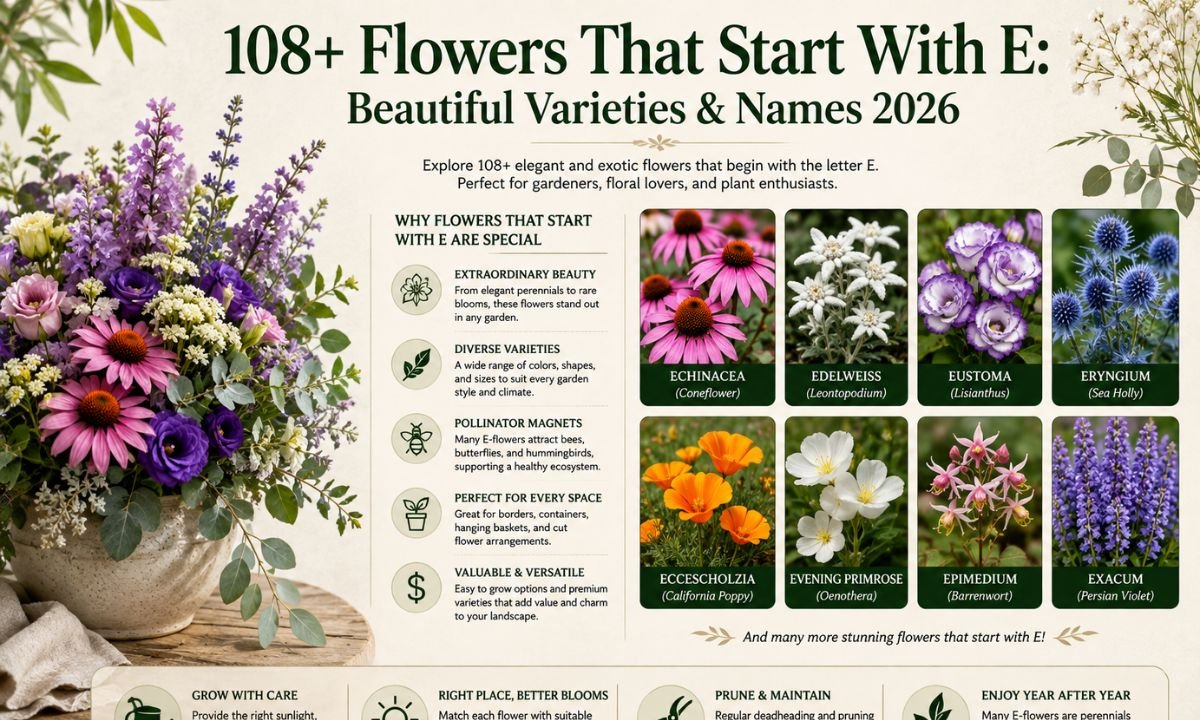
Flowers that start with E include Echinacea, English Daisy, Evening Primrose, Easter Lily, Edelweiss, Erica, Eryngium, and Eustoma. Some are garden classics, and others are rare botanical finds you won’t spot in a regular flower shop.
This guide covers over 108 flowers and flower varieties that start with the letter E, along with their meanings, growing tips, and best uses in the garden.
Whether you’re naming a baby girl, picking blooms for a wedding, or just building your flower knowledge, this list has something useful for you.
Best Picks At A Glance
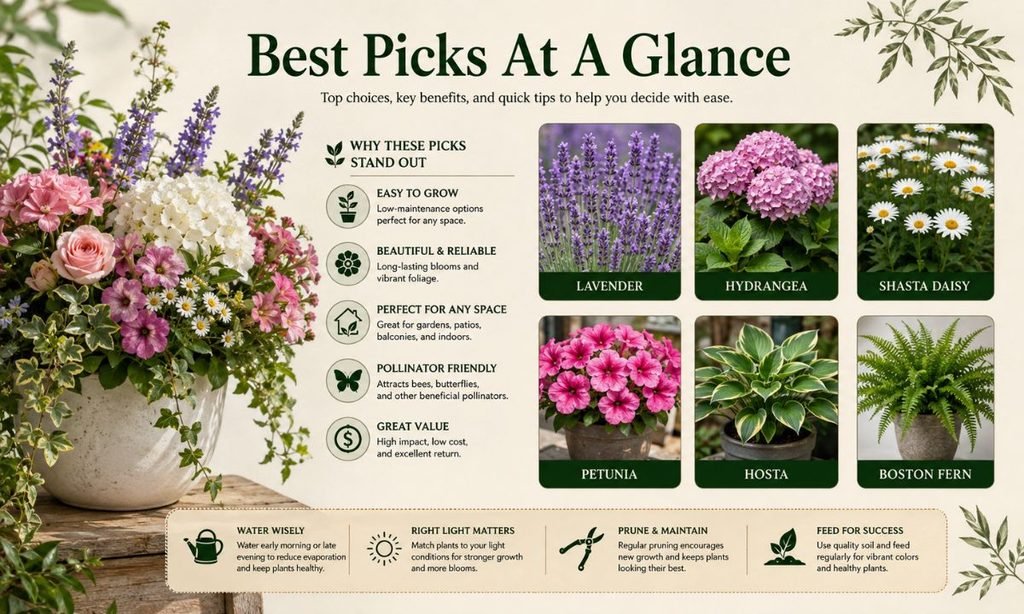
If you only remember a few names, start here. These are the most popular and easiest to find E flowers.
| Flower | Type | Best For |
| Echinacea | Perennial | Pollinator gardens |
| Easter Lily | Bulb | Holiday decor, gifts |
| English Lavender | Perennial herb | Fragrance, borders |
| Evening Primrose | Biennial/Perennial | Night gardens |
| English Daisy | Annual/Perennial | Ground cover, edging |
| Eustoma (Lisianthus) | Annual | Cut flowers, bouquets |
Complete List of 80 Flowers That Start With E
Here’s a working list of E flowers, from common to lesser known. Names include species and popular garden varieties.
| Flower Name | Flower Name | Flower Name | Flower Name |
| Easter Lily | Echinacea | Edelweiss | Egyptian Star Cluster |
| Elderflower | Elephant Ear Flower | Empress Tree Flower | English Bluebell |
| English Daisy | English Lavender | English Marigold | English Rose |
| Epidendrum Orchid | Epimedium | Eranthis (Winter Aconite) | Eremurus (Foxtail Lily) |
| Erica (Heather) | Erigeron (Fleabane) | Eryngium (Sea Holly) | Erysimum (Wallflower) |
| Eschscholzia (California Poppy) | Eucharis (Amazon Lily) | Eucomis (Pineapple Lily) | Euphorbia |
| European Peony | Eustoma (Lisianthus) | Evening Primrose | Everlasting Daisy |
| Exacum (Persian Violet) | Eyelash Orchid | Elephant Bush Flower | Elk’s Horn Fern Bloom |
| Emu Bush | Ehretia Flower | Elm Tree Flower | Emilia (Tassel Flower) |
| Echeveria Flower | Echium (Viper’s Bugloss) | Eucalyptus Blossom | Eryngium Planum |
| English Ivy Flower | English Wallflower | Everlasting Sweet Pea | Ecuadorian Orchid |
| Edging Lobelia | Echinops (Globe Thistle) | Erythronium (Trout Lily) | Erythrina (Coral Tree) |
| Elephant’s Foot Flower | Elegant Clarkia | Egyptian Lotus | Emerald Feather |
| Encyclia Orchid | Ensete Flower | Epacris (Coral Heath) | Eranthemum |
| Erica Carnea | Erica Gracilis | Escallonia | Ethiopian Banana Flower |
| Eucryphia | Eugenia Blossom | Euonymus Flower | Eupatorium (Joe Pye Weed) |
| Everlasting Flower | Everlasting Statice | Exochorda (Pearl Bush) | Eyelash Begonia |
| Ecballium (Squirting Cucumber Flower) | Echinacea Purpurea | Echinacea White Swan | English Rose Gertrude Jekyll |
| Eustoma Grandiflorum | Evening Star Flower | Erica Verticillata | Elderberry Blossom |
Combine species with their popular cultivars and you reach well past 108 named blooms and varieties. This list gives you a solid starting point for any project.
Also Read This: 69 Beautiful Variety Of Flowers That Start With A You Didn’t Know About 2026
Flowers That Start With E For Girl
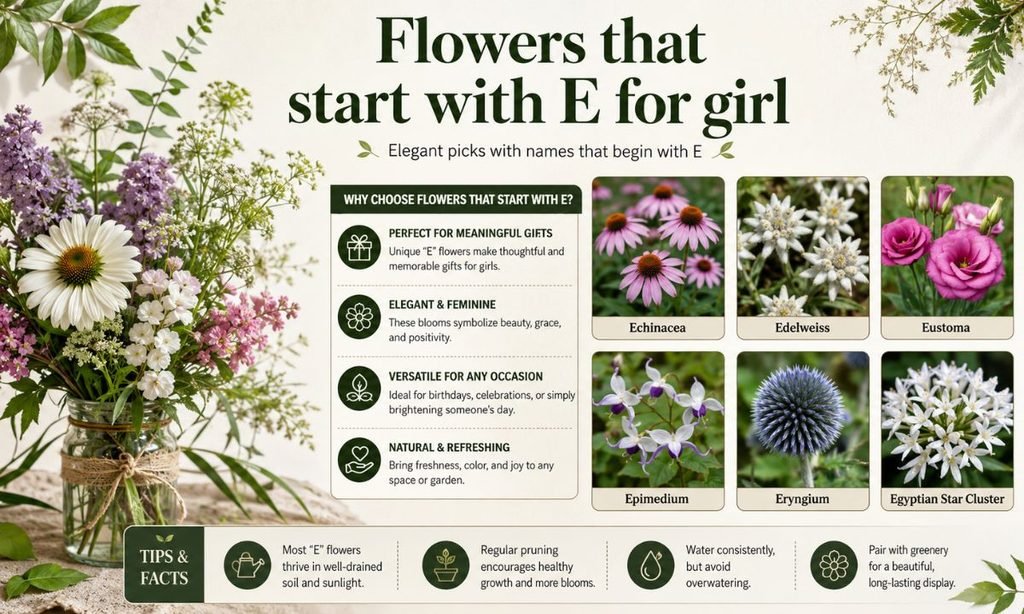
Flower names make sweet, meaningful baby names. Here are E flowers that work well as girl names.
- Eden: Tied to gardens and paradise, simple and timeless
- Elowen: A Cornish name meaning “elm tree,” soft and unique
- Erica: Directly from the heather flower, gentle and floral
- Eustoma: Unusual, but the flower itself is called the “rose of the prairie”
- Evening: Inspired by Evening Primrose, poetic and rare
Beautiful Variety Of Flowers That Start With E For Girl
Beyond direct names, some E flower varieties carry qualities parents love for daughters: grace, resilience, and beauty.
English Rose varieties often carry romantic names like “Emily” or “Eglantyne,” which double as girl names themselves. Echinacea symbolizes strength and healing, a meaningful nod for a strong-willed daughter. Evening Primrose blooms at dusk, which some parents like for a child born in the evening hours.
Flower Or Plant Beginning With E
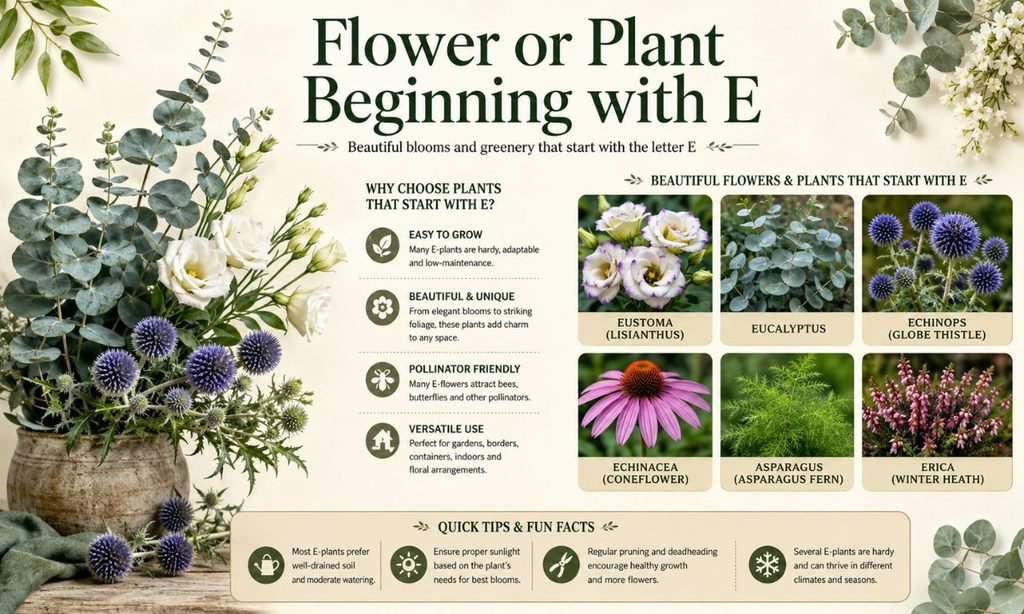
Not everything on this list is strictly a flower. Some are plants known mainly for their leaves, structure, or fragrance, with flowers as a secondary feature.
| Name | Flower or Plant | Known For |
| Elephant Ear | Plant | Large leaves, small flower spikes |
| English Ivy | Plant | Foliage, occasional small blooms |
| Eucalyptus | Plant/Tree | Aroma, fluffy white blossoms |
| Echeveria | Succulent plant | Rosette shape, small star flowers |
| Elm Tree | Tree | Shade, tiny green flowers in spring |
Quick Comparison
| Feature | Easter Lily | Echinacea | Evening Primrose |
| Bloom Season | Spring | Summer to fall | Summer |
| Height | 2 to 3 feet | 2 to 4 feet | 1 to 5 feet |
| Sun Needs | Partial to full sun | Full sun | Full sun |
| Fragrance | Strong, sweet | Mild | Strong, lemony |
| Difficulty | Easy | Easy | Moderate |
Featured Flower Profiles
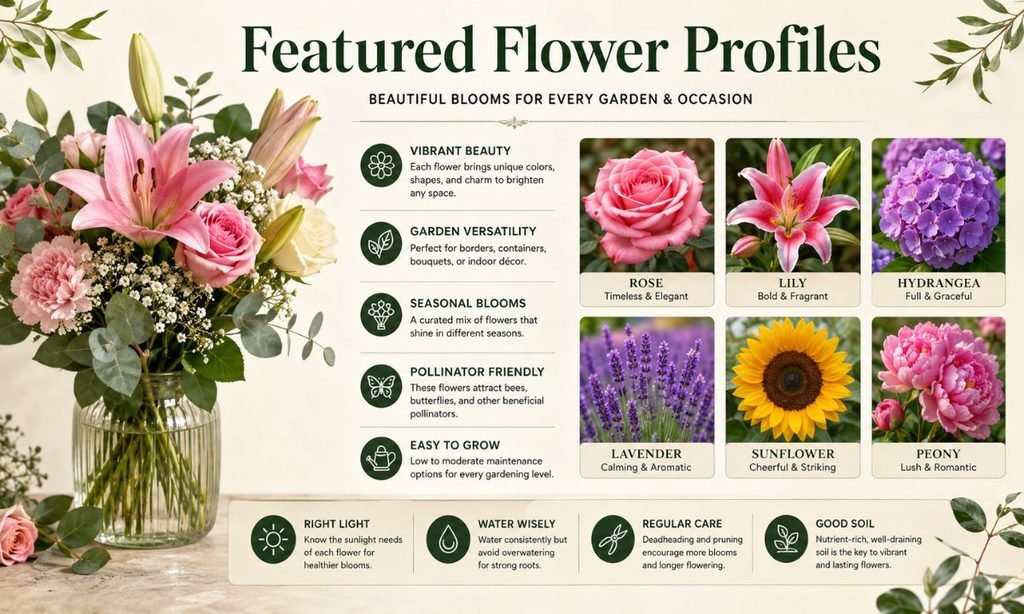
A few E flowers deserve extra attention because of how often they show up in gardens, bouquets, and gifts.
Echinacea stands out for its daisy-like petals and spiky orange center. Gardeners love it because it attracts bees and butterflies while surviving droughts without much fuss. Easter Lily, on the other hand, is a holiday staple. Its trumpet-shaped white blooms and heavy fragrance make it a go-to gift during spring celebrations.
Eryngium, commonly called Sea Holly, brings a completely different look. Its spiky, metallic blue flower heads add texture to dried arrangements and modern floral designs. Eustoma, better known as Lisianthus, mimics the look of a rose but with a softer, ruffled petal structure that florists often prefer for weddings.
Flower Meanings And Symbolism
Flowers carry meaning, and E flowers are no exception. Here’s what some of the most popular ones represent.
| Flower | Meaning |
| Easter Lily | Purity, rebirth, hope |
| Echinacea | Strength, healing |
| English Daisy | Innocence, new beginnings |
| Evening Primrose | Silent love, memory of a loved one |
| Erica (Heather) | Admiration, good luck |
| Eustoma | Charisma, appreciation |
These meanings make E flowers popular choices for sympathy arrangements, weddings, and get well gifts.
Common Flowers That Start With E
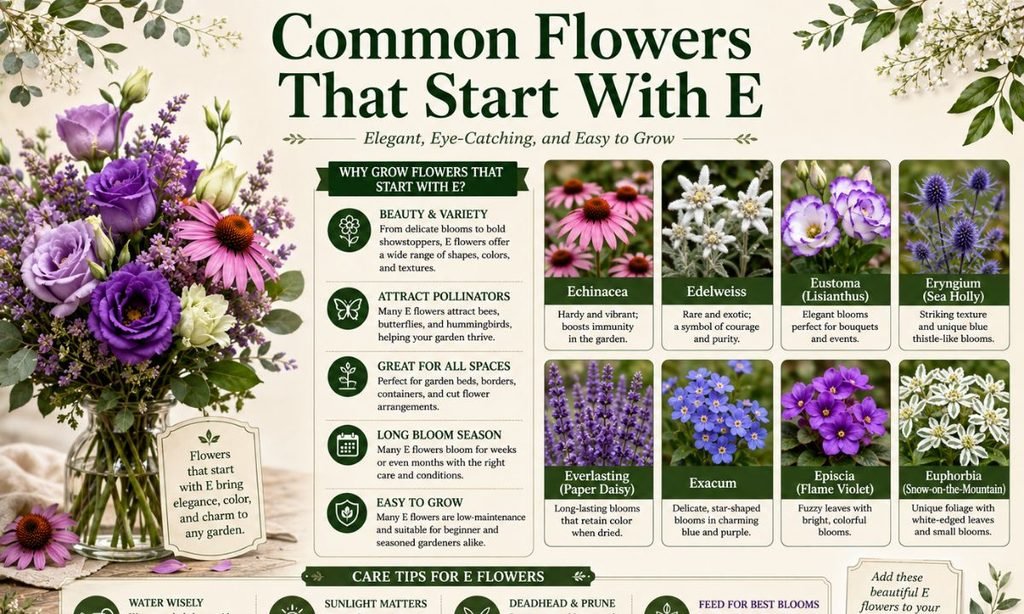
These six flowers are the ones you’re most likely to see in gardens, florist shops, or even growing wild.
Easter Lily
The Easter Lily produces large, trumpet-shaped white flowers with a heavy, sweet scent. It blooms in spring and is closely tied to the Easter holiday, symbolizing purity and new life. This lily grows from a bulb and does best in well-drained soil with partial sunlight. Indoors, it’s often forced to bloom early for holiday sales, which is why you’ll spot it in stores well before its natural outdoor bloom time.
Echinacea
Also called the purple coneflower, Echinacea is one of the toughest perennials you can plant. It handles poor soil, drought, and neglect while still producing bold, daisy-like blooms all summer. Bees and butterflies flock to it, making it a favorite for pollinator gardens. Beyond looks, Echinacea roots have a long history of traditional use, though that’s a separate topic from its garden value.
English Daisy
The English Daisy is small but mighty, with tight, round blooms that come in white, pink, or red. It’s often used as a border plant or ground cover since it stays low and spreads easily. This daisy prefers cool weather and can struggle in extreme summer heat, so many gardeners treat it as a spring or fall bloomer.
Evening Primrose
Evening Primrose earns its name honestly. Its pale yellow flowers open in the late afternoon and stay open through the night, closing again by midday. This makes it a favorite for moon gardens or spaces meant to be enjoyed after sunset. It also has a light lemony scent that becomes more noticeable in the evening air.
English Lavender
English Lavender is prized for its fragrance as much as its looks. The narrow purple flower spikes grow on silvery green stems and are commonly dried for sachets, oils, and culinary uses. It thrives in full sun and well-drained soil, and it doesn’t like wet feet, so overwatering is the most common mistake gardeners make with it.
English Bluebell
English Bluebell produces nodding, bell-shaped blue flowers that carpet woodland floors in spring. It’s a shade-loving plant, unlike many other bulbs, and spreads naturally over time to form dense colonies. Gardeners often use it under trees or in naturalized areas where other flowers struggle to grow.
Common Names And Scientific Names
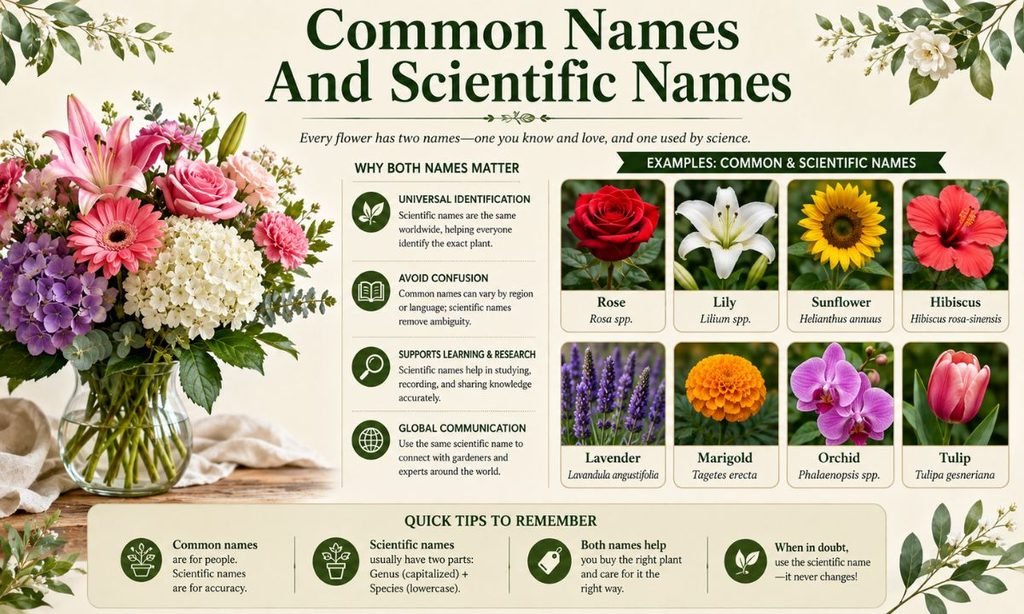
| Common Name | Scientific Name |
| Easter Lily | Lilium longiflorum |
| Echinacea | Echinacea purpurea |
| English Daisy | Bellis perennis |
| Evening Primrose | Oenothera biennis |
| English Lavender | Lavandula angustifolia |
| English Bluebell | Hyacinthoides non scripta |
| Edelweiss | Leontopodium alpinum |
| Eustoma | Eustoma grandiflorum |
Quick Identification Guide
Not sure what flower you’re looking at? Use these quick clues to narrow it down.
- Trumpet shaped, white, fragrant: likely Easter Lily
- Purple daisy shape with spiky center: likely Echinacea
- Small round blooms, low growing: likely English Daisy
- Pale yellow, opens at dusk: likely Evening Primrose
- Purple spikes, strong scent: likely English Lavender
- Blue, bell shaped, found in woodland: likely English Bluebell
Expanded List Of Flowers Starting With E
Beyond the common names, here are more E flowers worth knowing for wider variety in garden design or floral projects.
- Eranthis (Winter Aconite)
- Eremurus (Foxtail Lily)
- Eryngium (Sea Holly)
- Erysimum (Wallflower)
- Eschscholzia (California Poppy)
- Eucomis (Pineapple Lily)
- Euphorbia
- Exacum (Persian Violet)
- Emilia (Tassel Flower)
- Erythronium (Trout Lily)
Rare Flowers That Start With E
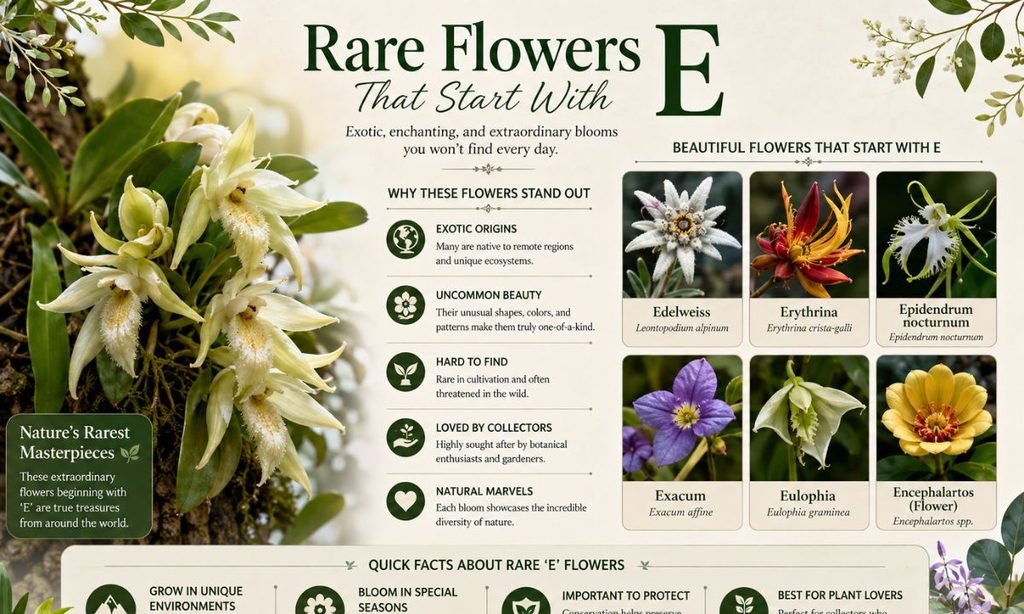
Some E flowers are harder to find and rarely show up in regular garden centers. These are worth searching out if you want something unusual.
| Flower | Why It’s Rare |
| Ecuadorian Orchid | Grows only in specific tropical climates |
| Eyelash Orchid | Requires very specific humidity and care |
| Erica Verticillata | Nearly extinct in the wild, conservation efforts ongoing |
| Encyclia Orchid | Limited to certain warm regions |
| Egyptian Lotus | Historically significant, less common today |
Best E Flowers By Color
Purple Flowers That Start With E
Purple is one of the most common colors among E flowers. Echinacea, English Lavender, Erica, and Exacum all bring shades of purple to the garden, ranging from soft lilac to deep violet. These flowers pair well together in a themed purple garden bed and tend to attract bees and butterflies in higher numbers than lighter colors.
Perennial Flowers That Start With E
Perennials come back year after year, making them a smart long-term investment for any garden.
- Echinacea
- English Lavender
- English Daisy
- Eryngium
- Epimedium
- Erica
Annual Flowers That Start With E
Annuals complete their life cycle in one season, which means fresh planting each year but often bigger, faster blooms.
- Eustoma (Lisianthus)
- Eschscholzia (California Poppy)
- Emilia (Tassel Flower)
Indoor Flowers That Start With E
Some E flowers do well in pots and indoor settings, especially with bright, indirect light.
| Flower | Light Needs | Watering |
| Easter Lily | Bright, indirect | Moderate |
| Echeveria | Full sun | Low |
| Eucharis (Amazon Lily) | Bright, indirect | Moderate |
| Exacum (Persian Violet) | Bright, indirect | Moderate |
Fragrant E Named Flowers
If scent matters to you, these E flowers deliver the strongest fragrance.
- Easter Lily, heavy sweet scent
- English Lavender, herbal and calming
- Evening Primrose, lemony and light
- Elderflower, floral and slightly fruity
Which E Flowers Are Good For Beginners?
New gardeners should start with flowers that forgive mistakes. Echinacea and English Lavender both tolerate dry spells and poor soil, which makes them nearly impossible to kill with basic care. English Daisy is another safe pick since it doesn’t need much beyond regular watering and some sun.
Avoid starting with orchids like the Eyelash Orchid or Encyclia Orchid if you’re new to gardening. These need specific humidity and temperature ranges that take experience to manage well.
Plants Vs Flowers That Start With E
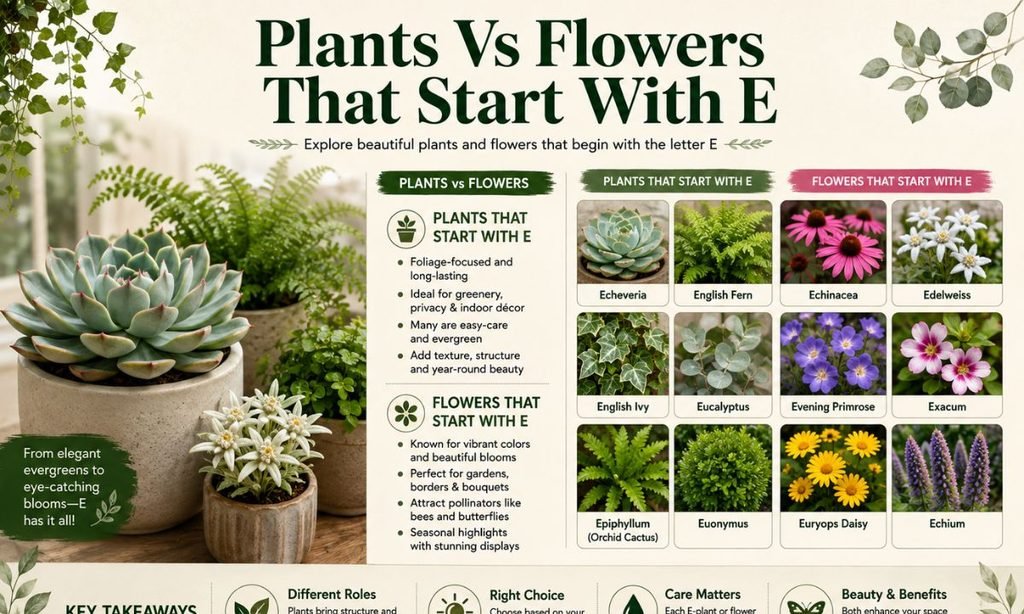
It helps to know the difference before you go shopping. A flower is the blooming part of a plant, while some E named entries on this list refer to the whole plant, which may or may not flower depending on conditions. Elephant Ear and English Ivy, for example, are grown mainly for foliage. Eucalyptus is technically a tree that produces small blossoms, but most people grow it for its leaves and scent, not the flower itself.
Types Of Flowers That Start With E
E flowers fall into a few broad categories based on growth habit and use.
| Category | Examples |
| Bulb flowers | Easter Lily, English Bluebell, Eremurus |
| Wildflowers | Evening Primrose, Eschscholzia |
| Shrub flowers | Erica, Escallonia, Exochorda |
| Cut flowers | Eustoma, Everlasting Daisy |
| Orchids | Epidendrum, Encyclia, Eyelash Orchid |
Best E Flowers By Growing Condition
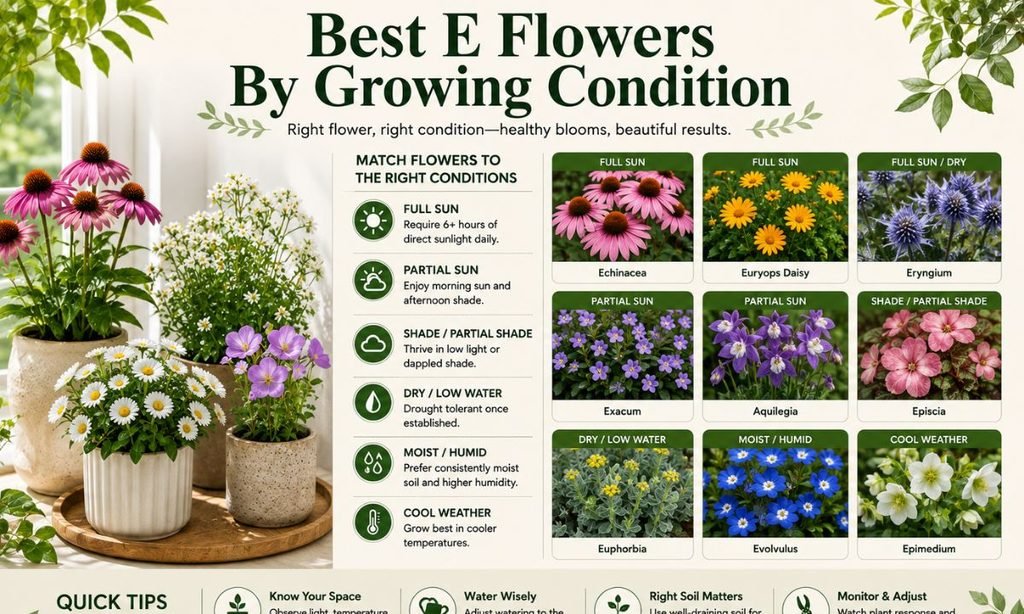
| Condition | Best E Flowers |
| Full sun | Echinacea, Eschscholzia, English Lavender |
| Partial shade | English Bluebell, Epimedium |
| Dry soil | Echinacea, Erica |
| Moist soil | Evening Primrose, Eucharis |
| Cold climates | English Daisy, Eranthis |
How To Choose The Right E Flower By Garden Use
Think about what you actually need the flower for before picking one. If you want pollinators, Echinacea and Erysimum draw in bees consistently. For cut flower arrangements, Eustoma and Everlasting Daisy hold up well in a vase and keep their shape for days. If fragrance is the goal, English Lavender and Evening Primrose bring the strongest scent without overwhelming a small space.
For low maintenance ground cover, English Daisy spreads well and handles foot traffic better than most flowering plants. And if you’re working with shade, English Bluebell is one of the few E flowers that actually prefers it over full sun.
Final Thoughts
Flowers that start with E cover a surprisingly wide range, from garden staples like Echinacea and English Lavender to rare finds like the Eyelash Orchid. Whether you’re planning a garden, picking a baby name, or building a bouquet, this letter offers more variety than most people expect.
Common picks like Easter Lily and Evening Primrose bring easy care and strong meaning, while rarer options give experienced growers something new to chase.
At the end of the day, the right E flower depends on what you need it for. Match your climate, sunlight, and purpose to the flower, and you’ll end up with blooms that actually thrive instead of just surviving. With over 108 names and varieties to choose from, there’s an E flower for nearly every garden and every occasion.

Jack Danniel is a flower enthusiast, writer, and experienced SEO expert passionate about creating helpful content.
With years of experience in SEO and content strategy, he shares engaging and informative insights about flowers.
His goal is to make floral information easy to understand while helping readers discover the beauty of nature.