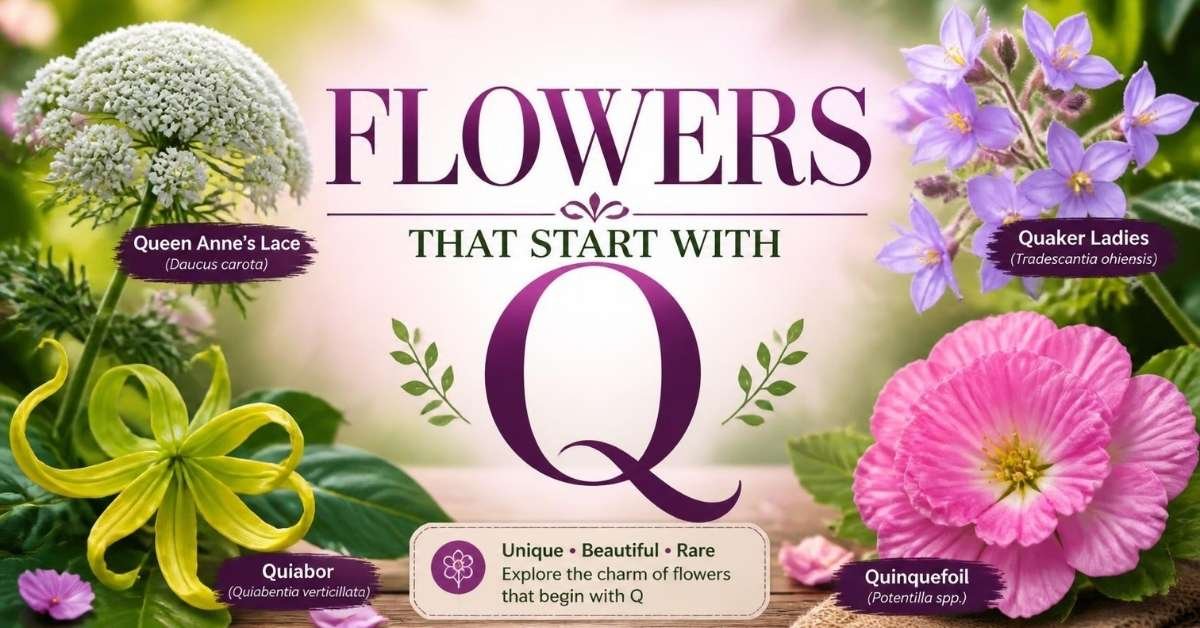
Ever tried naming a flower for every letter of the alphabet and gotten stuck at Q? You’re not alone. Most people can rattle off roses, tulips, and daisies without thinking twice, but flowers that start with Q trip up even seasoned gardeners.
Here’s the good news. There are more Q flower names out there than you’d guess, and some of them are genuinely stunning. From tiny woodland blooms to night-blooming cactus flowers, this list covers wildflowers, vines, shrubs, and a few plants you can grow right on your windowsill.
Quick Answer: What Are Flowers That Start With Q?
If you’re short on time, here’s the short version. Flowers that start with Q include Quaker Ladies, Queen Anne’s Lace, Queen’s Tears, Quince Blossoms, and Quisqualis, among others. Most of these are real, easy-to-find plants, not obscure botanical trivia.
Some grow wild in meadows and woodlands, while others are cultivated as container plants or indoor bromeliads. A handful are tropical, a handful are cold-hardy perennials, and a couple straddle both worlds depending on where you live.
This variety is actually what makes Q flowers fun to explore. You get wildflowers next to flowering vines, and cactus blooms sitting beside garden shrubs, all sharing one letter.
Popular Flower Names Starting With Q
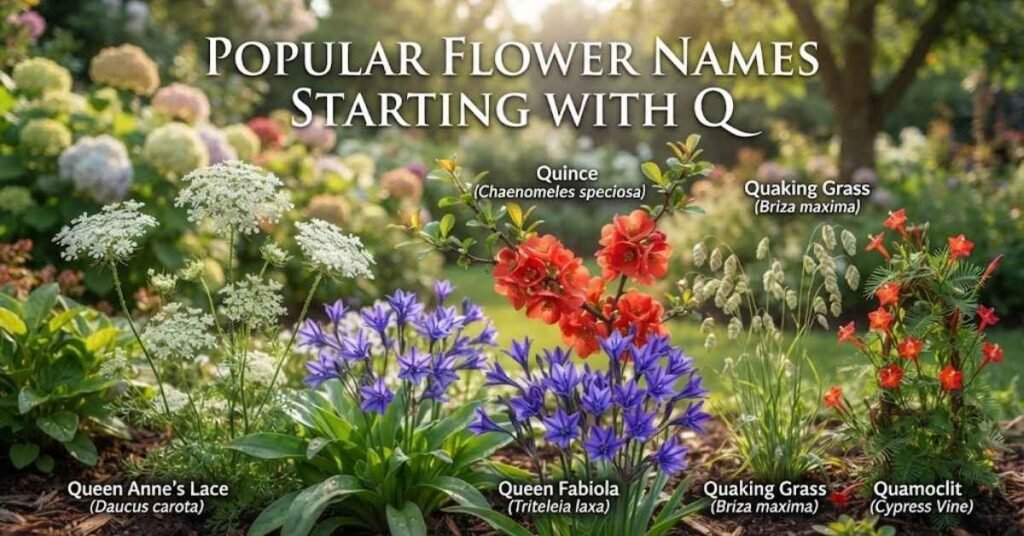
A few Q flowers show up again and again in gardens and nature guides. Queen Anne’s Lace is probably the most recognized, with its flat, lacy white clusters that pop up along roadsides every summer.
Queen’s Tears, a small indoor bromeliad, is another favorite because it’s nearly impossible to kill and blooms with unusual pink, green, and blue flowers. Quince Blossoms also get a lot of love each spring, especially in cottage gardens where their pink and coral petals open before the leaves even appear.
Then there’s Queen of the Night, a cactus flower with a reputation. It blooms for just one night, releases a heavy fragrance, and closes by morning. Gardeners plan entire evenings around watching it open.
20 Q Flower Names
Here’s a quick-reference list before we dig into details:
- Quaker Ladies
- Queen Anne’s Lace
- Queen’s Cup
- Queen’s Tears
- Queen of the Night
- Quamash (Camas)
- Quamoclit (Cypress Vine)
- Queen’s Wreath
- Quince Blossoms
- Queen of the Prairie
- Queen of the Meadow
- Queen Lily Ginger
- Queen of Sheba Orchid
- Queen’s Crape Myrtle
- Queen Fabiola
- Queen Red Lime Zinnia
- Queen’s Crown
- Qantuta
- Quesnelia
- Quisqualis (Rangoon Creeper)
Keep this list handy. We’ll walk through each category below, so you know where these plants actually thrive.
Types Of Flowers That Start With Q
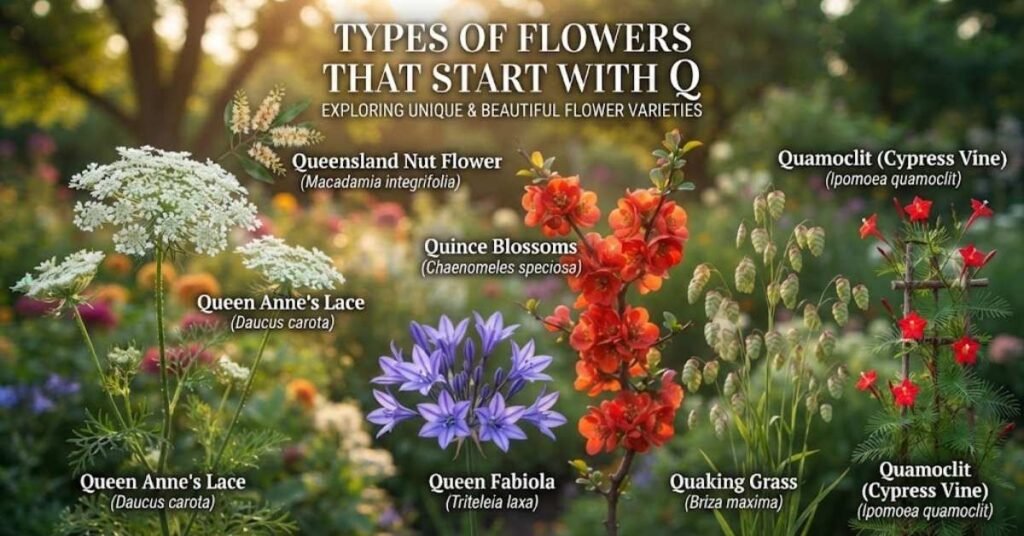
Q flowers don’t fit into one neat box. They span wildflowers, flowering vines, shrubs, and bulb perennials, each with its own growing habits and garden uses.
Breaking them into categories makes it easier to figure out which ones suit your climate and space. A balcony gardener needs different picks than someone with a full acre of meadow to plant.
Wildflowers And Meadow Plants
Quaker Ladies (Houstonia caerulea) are tiny, four-petaled blue flowers native to North America. They naturalize in lawns and meadow gardens, forming soft carpets in early spring.
Queen Anne’s Lace (Daucus carota) is a biennial wildflower with delicate, lace-like flower clusters. It’s a pollinator-friendly plant, but it’s also a relative of the wild carrot and can spread aggressively as a naturalizing plant, so check your local guidance before letting it loose.
Queen of the Prairie (Filipendula rubra) brings fluffy pink plumes to wet meadows and rain gardens. It loves moisture-loving conditions and adds real height and texture to native plant beds.
Vines And Climbers
Quamoclit, better known as cypress vine (Ipomoea quamoclit), is a fast-growing climber with star-shaped red flowers that hummingbirds can’t resist. It’s an annual vine, easy to grow from seed on a trellis or fence.
Queen’s Wreath (Petrea volubilis) is a tropical vine covered in purple, wisteria-like clusters. In warm climates it drapes beautifully over pergolas and arbors.
Quisqualis, or Rangoon creeper (Combretum indicum), is famous for its color-changing blooms. Flowers open white, then shift to pink, then deepen to red, all on the same vine at once.
Shrubs And Flowering Trees
Quince Blossoms come from Chaenomeles species, flowering shrubs prized for early spring color before their leaves unfurl. They handle partial shade and make a strong ornamental hedge.
Queen’s Crape Myrtle (Lagerstroemia speciosa) is a flowering tree with showy purple-pink clusters, popular in warm-climate landscaping and street planting across tropical regions.
Bulbs And Perennials That Start With Q
Quamash, or camas (Camassia quamash), produces striking blue star-shaped flowers each spring. It’s a bulb perennial native to the Pacific Northwest, and historically an important food source for Indigenous communities in that region.
Queen Fabiola, a cultivar of Triteleia laxa, offers violet-blue clusters on wiry stems, making it a lovely addition to cut flower beds and borders.
Purple Flowers That Start With Q
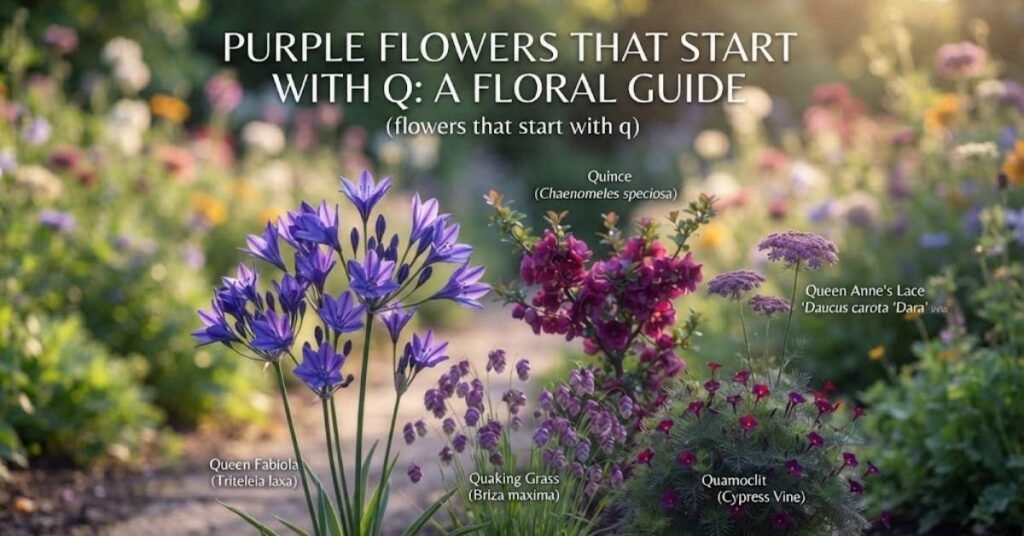
If purple is your color, Q flowers deliver. Queen’s Wreath and Queen’s Crape Myrtle both bring rich violet tones, one as a climbing vine and the other as a flowering tree.
Quamash offers a softer, blue-violet shade, while Queen Fabiola leans more toward true violet-blue. Together, these plants give you options across every growth habit, from ground-level bulbs to overhead vines.
For a shaded, woodland feel, pair purple flowering vines like Queen’s Wreath with lower-growing violet perennials. The contrast between climbing color and ground cover reads as intentional, not accidental.
Rare Flowers That Start With Q
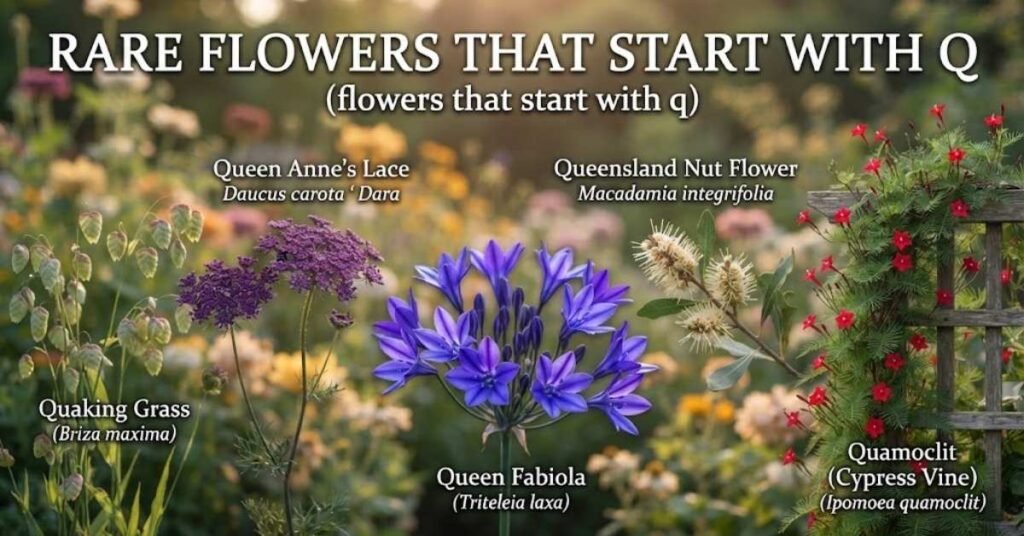
Some Q flowers are genuinely hard to find, and that’s part of their appeal. Queen of Sheba Orchid (Thelymitra variegata) is a terrestrial orchid native to Australia, with striking rainbow-colored petals that only open in full sun.
Qantuta (Cantua buxifolia), also called the sacred flower of the Incas, holds cultural value in Peru and Bolivia and is recognized as the national flower of both countries. It grows as an Andean shrub with tubular, multicolored blooms.
Quesnelia, a bromeliad genus, is less common outside specialty nurseries but rewards patient growers with striking bracts and tropical foliage. If you’re chasing rare plants, always buy from trusted nurseries or botanical gardens rather than wild collection, since some habitat-specific species are conservation-sensitive.
Annual Flowers That Start With Q
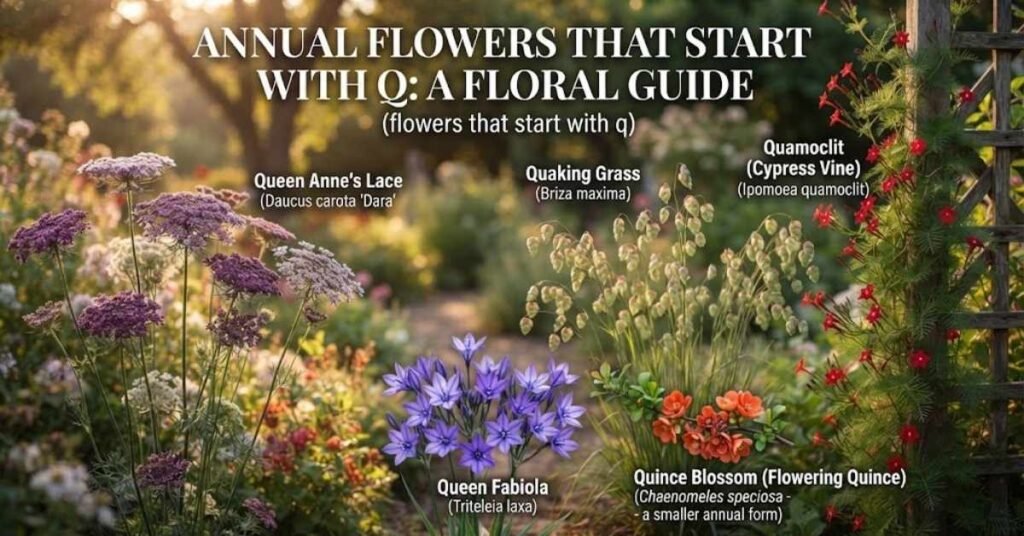
Not every Q flower is a long-term commitment. Queen Red Lime Zinnia (Zinnia elegans) is a warm-season annual with unusual green-and-burgundy petals that fade beautifully as they age.
Quamoclit also falls into this category, since cypress vine is typically grown fresh from seed each year in temperate climates. Both are beginner-friendly and reward you with color fast.
Container Flowers With Q
Limited on space? Several Q flowers do just fine in pots. Queen’s Tears thrives in a potting mix with sharp drainage, making it ideal for patio containers and hanging baskets.
Queen Red Lime Zinnia also handles container life well, as long as it gets full sun and consistent watering. Its compact size fits neatly on a sunny balcony or patio ledge.
For something more architectural, Quesnelia bromeliads work beautifully in deep pots on a covered patio, especially in regions where winter protection is needed.
Indoor Flowers With Q
Bringing Q flowers indoors mostly means bromeliads and cacti. Queen’s Tears is the standout here, tolerating bright indirect light and minimal fuss, which makes it a forgiving houseplant for beginners.
Queen of the Night, when grown as a potted epiphytic cactus, can also live indoors near a bright window. Just remember it needs warm temperatures and a bit of patience, since it may only bloom once or twice a year.
Both plants reward you with unexpected color in an otherwise green indoor jungle.
Best Q Flowers For Home Gardens
For most home gardeners, a mix of easy and eye-catching works best. Queen Anne’s Lace and Quaker Ladies are simple, low-maintenance choices for a cottage or wildflower-style bed.
If you want more drama, plant Quince Blossoms as a spring-flowering hedge and let Quamoclit climb a nearby fence for summer color. This combination gives you blooms from early spring straight through to fall.
Queen of the Prairie suits anyone with a damp corner of the yard that other plants struggle with, turning a tricky spot into a showpiece.
Which Q Flowers Smell The Best?
Fragrance is where Queen of the Night truly shines. Its heavy, sweet evening fragrance is intense enough to fill an entire room or patio during its single night of bloom.
Quisqualis also carries a strong, sweet scent, especially in the evening, which is part of why it’s such a popular tropical vine near seating areas. Queen of the Meadow (meadowsweet) offers a gentler, herbal scent, often used historically in herbal remedies and natural fragrance blends.
Tropical Vs Temperate Q Flowers
Not all Q flowers can handle the same climate, so it helps to sort them by temperature needs. Queen’s Wreath, Quisqualis, and Queen’s Crape Myrtle are true tropical plants, needing frost-free conditions and high humidity to thrive.
On the other end, Quaker Ladies, Quamash, and Queen of the Prairie are temperate natives, comfortable with cool winters and seasonal dormancy. If you live somewhere with real frost, stick to the temperate group outdoors and save the tropical picks for containers you can bring inside.
Meaning And Symbolism Of Flowers Starting With Q
Flower symbolism adds another layer of interest here. Queen Anne’s Lace is often linked to delicate beauty and sanctuary, fitting for a flower that shelters tiny insects within its lacy clusters.
Quince Blossoms carry associations with love and fertility in several cultures, partly because the fruit ripens after the flowers fade, symbolizing patience and reward. Qantuta, given its status as a national flower, represents pride, heritage, and celebration across Andean communities.
Even smaller blooms like Quaker Ladies carry meaning, often tied to simplicity and friendship, thanks to their unassuming, cheerful appearance in lawns and meadows.
How Many Flowers Start With The Letter Q?
Compared to letters like A or B, Q is genuinely rare in the plant world. Still, once you widen the search beyond common English names to scientific names, regional names, and cultivar names, the list grows well past 20 distinct plants.
This article covers the most recognizable and garden-worthy options, but botanical databases and regional plant guides list plenty more, especially among orchids, bromeliads, and lesser-known wildflowers.
Edible Plants Vs Flowers That Start With Q
A few Q plants blur the line between ornamental and edible. Quamash bulbs were historically roasted and eaten by Indigenous peoples of the Pacific Northwest, making it both a native plant and a food source.
Quince, meanwhile, produces fruit after its blossoms fade, and that fruit is commonly cooked into jams and preserves. The flowers themselves aren’t eaten, but they signal the start of the fruiting season.
Queen Anne’s Lace deserves a caution here. While its root smells like carrot and shares the same family, it closely resembles poison hemlock, a toxic lookalike. Never eat wild Queen Anne’s Lace unless you’re certain of positive identification.
Safety And Regional Notes
Speaking of safety, a few practical notes are worth remembering. Queen Anne’s Lace can act as an aggressive spreader in some regions and is even classified as a restricted plant in parts of the US, so check local guidance before planting it deliberately.
Quince shrubs have thorny branches, which is worth knowing if you’re planting near a path or somewhere kids play. And with rare or wild-collected species like orchids and bromeliads, always confirm they came from trusted nurseries rather than wild collection, both for legal reasons and conservation.
If you have pets, double check toxicity before bringing any new plant indoors, since not every “pollinator-friendly” plant is automatically pet-safe.
Conclusion
Q flowers might not be the first names that come to mind, but they hold their own once you actually look. Between wildflowers like Queen Anne’s Lace, tropical showstoppers like Queen’s Wreath, and easy houseplants like Queen’s Tears, there’s a Q flower for nearly every kind of garden and gardener.
Try adding one or two to your own space this season. You might just find your new favorite bloom hiding behind an unexpected letter.
FAQ’s
What Is The Most Popular Flower That Starts With Q?
Queen Anne’s Lace is the most widely recognized, thanks to its common presence in fields and roadside meadows across North America and Europe.
What Are Common Flowers That Start With Q?
Common options include Queen Anne’s Lace, Quince Blossoms, Queen’s Tears, and Quamoclit, all of which are easy to find at nurseries or in the wild.
Which Flowers That Start With Q Are Perennials?
Quamash, Queen of the Prairie, Queen of the Meadow, and Quaker Ladies are all perennials that return year after year in the right climate.
Are There Indoor Flowers That Start With Q?
Yes. Queen’s Tears is a popular indoor bromeliad, and Queen of the Night can be grown as a potted cactus near a bright window.
Which Q Flowers Are Good For Beginners?
Queen Anne’s Lace, Quaker Ladies, and Queen Red Lime Zinnia are all forgiving choices for beginner gardeners.
What Are Rare Flowers That Start With Q?
Queen of Sheba Orchid, Qantuta, and Quesnelia are considered rare or less commonly available outside specialty growers.
What Purple Flowers Start With Q?
Queen’s Wreath, Queen’s Crape Myrtle, and Quamash all produce purple or violet-blue blooms.
Are All Q Flowers True Flowers?
Most are, though a few names like Quince refer to a shrub known primarily for its blossoms and later its fruit, so the naming sometimes overlaps between flower and fruiting plant.
Can Q Flowers Grow In Containers?
Yes. Queen’s Tears, Quesnelia, and Queen Red Lime Zinnia all adapt well to container gardening on patios or balconies.

Jack Danniel is a flower enthusiast, writer, and experienced SEO expert passionate about creating helpful content.
With years of experience in SEO and content strategy, he shares engaging and informative insights about flowers.
His goal is to make floral information easy to understand while helping readers discover the beauty of nature.