Will it peel in a year? Does it turn yellow? And what will it really cost per square foot? Those are the worries most people have before they pick epoxy flooring.
Short answer: yes, it’s a smart pick for most garages, workshops and busy commercial spaces.
It only works when the concrete floor is dry, clean and prepared the right way.
TLDR: Is Epoxy Flooring A Good Choice?
Epoxy gives you a tough, seamless flooring surface that shrugs off oil, tire marks and daily wear.
You also get easy cleaning and plenty of decorative flooring options.
The catches are real, though.
It can be slippery when wet, it can yellow in strong sun, and it fails fast over damp concrete slab floors.
Think of it as a great tool with a short instruction manual.
Follow the manual and it pays you back for years.
What Is Epoxy Resin Flooring?
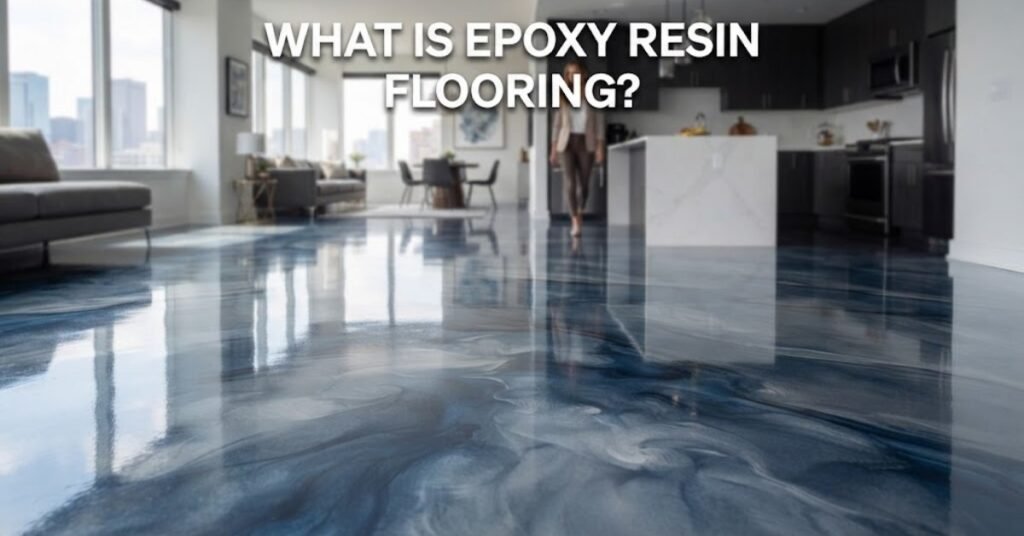
Epoxy resin flooring is a hard plastic layer that bonds to your concrete.
It starts as liquid and cures into a protective coating.
You’ll hear it called resin flooring, a floor system or an epoxy floor coating.
They overlap a lot, and we’ll sort out the differences later.
What Is Epoxy Flooring Made Of?
Two liquids make the magic happen: the resin and the hardener.
Mix them and a chemical reaction turns them into a solid.
That’s basic resin chemistry, and it explains why the mixing ratio matters so much.
Get it wrong and you’ll see sticky areas or an uneven cure.
Basic Epoxy Flooring Materials List
Here’s what a typical job uses:
- Epoxy resin and hardener (two-part epoxy)
- Primer, sometimes a moisture barrier primer
- Pigment for color
- Decorative flakes or quartz aggregate for texture
- Clear topcoat, ideally a UV stable topcoat
- Anti-slip additive or grit additive
Why Material Quality Matters
Cheap kits often hide a thin, watered-down formula.
Check the product datasheet for solids content, cure time and chemical resistance.
A good datasheet reads like a nutrition label.
If the maker won’t share one, walk away.
How Epoxy Flooring Works
Each layer has one job, and the layers work as a team.
Skip one and the whole floor system gets weaker.
Picture a sandwich.
The bread holds everything together, and the filling gives it character.
Concrete Substrate
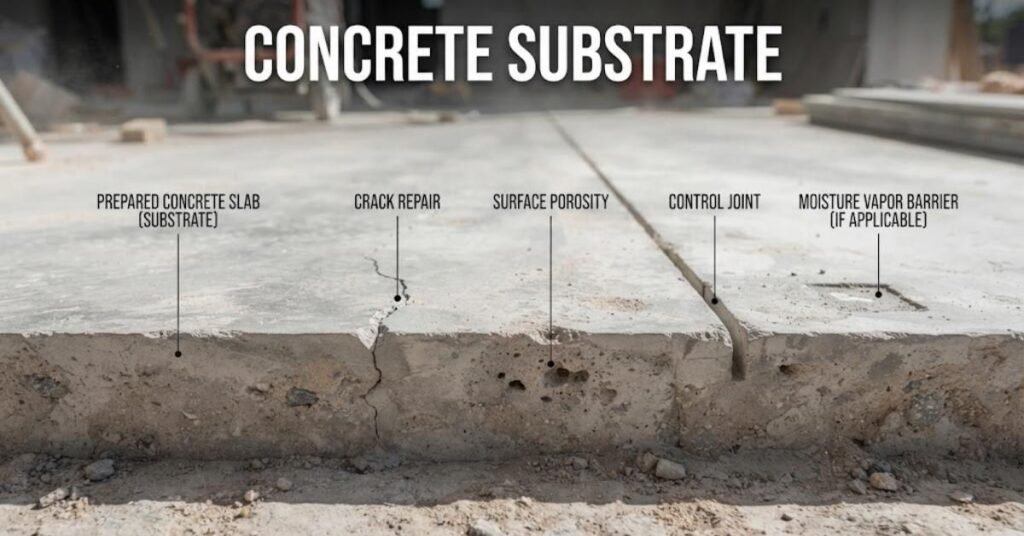
Your concrete substrate is the foundation.
Epoxy only sticks as well as the concrete under it.
A weak, dusty or oily surface leads to poor bonding and weak adhesion.
That’s why surface preparation gets more time than the coating itself.
Primer And Base Coat
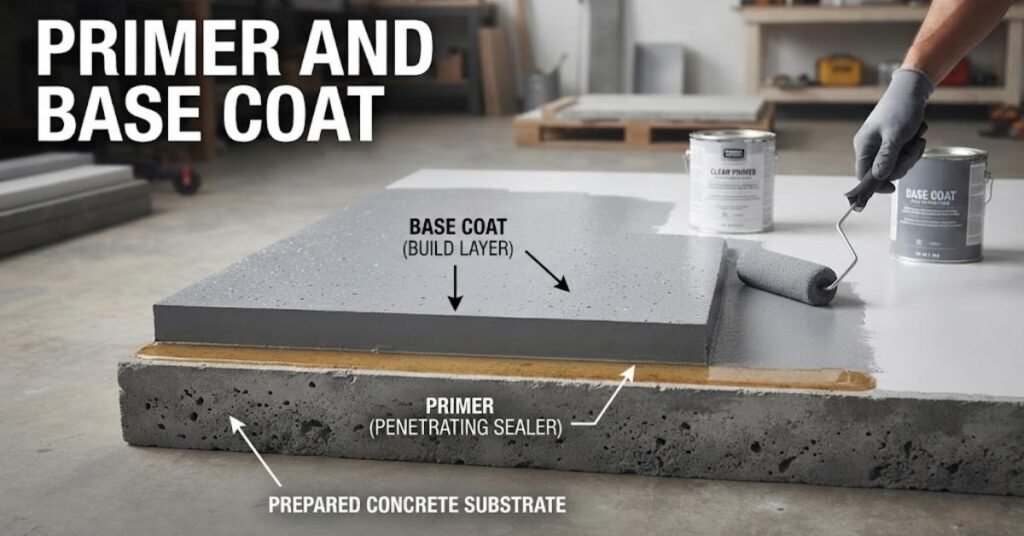
The primer soaks into the pores and locks the system to the slab.
Then the base coat, sometimes called the body coat, builds color and thickness.
Good adhesion starts here.
Rush this step and you’ll pay for it later.
Decorative Layer And Topcoat
Next comes the broadcast material, like color flakes or quartz, tossed onto wet resin.
Then the finish coat seals it all in.
The topcoat handles scratches, UV and spills.
Pick the gloss level here too.
Types Of Epoxy Flooring
Not every epoxy floor looks or behaves the same.
The right type depends on traffic, budget and style.
Let’s walk through the main options.
Keep your own space in mind as you read.
Self-Leveling Epoxy
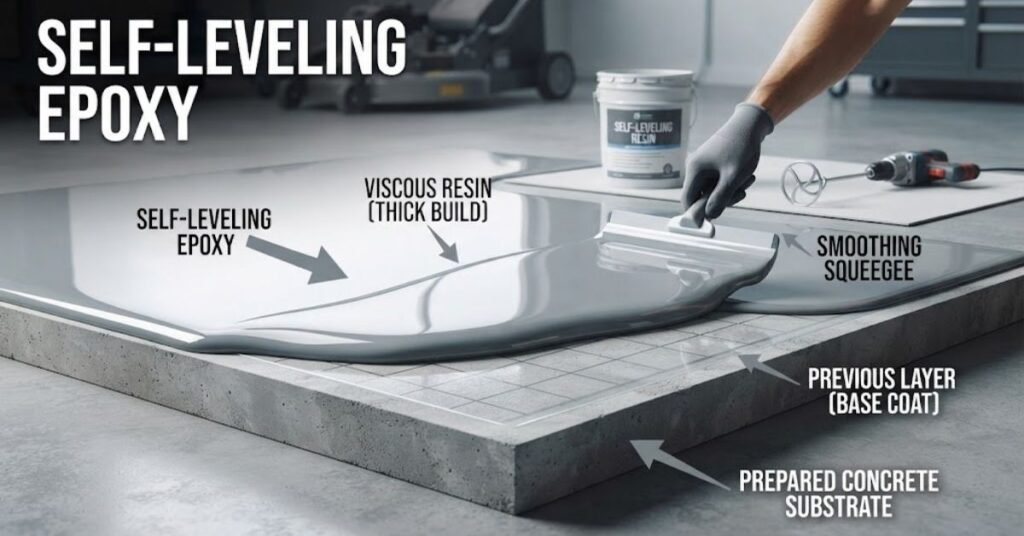
Self-leveling epoxy flows out smooth like pancake batter.
It hides small dips and gives a glass-like, seamless surface.
It suits showrooms, labs and clean areas.
It also shows every flaw in the slab, so repairs come first.
Epoxy Flake Flooring
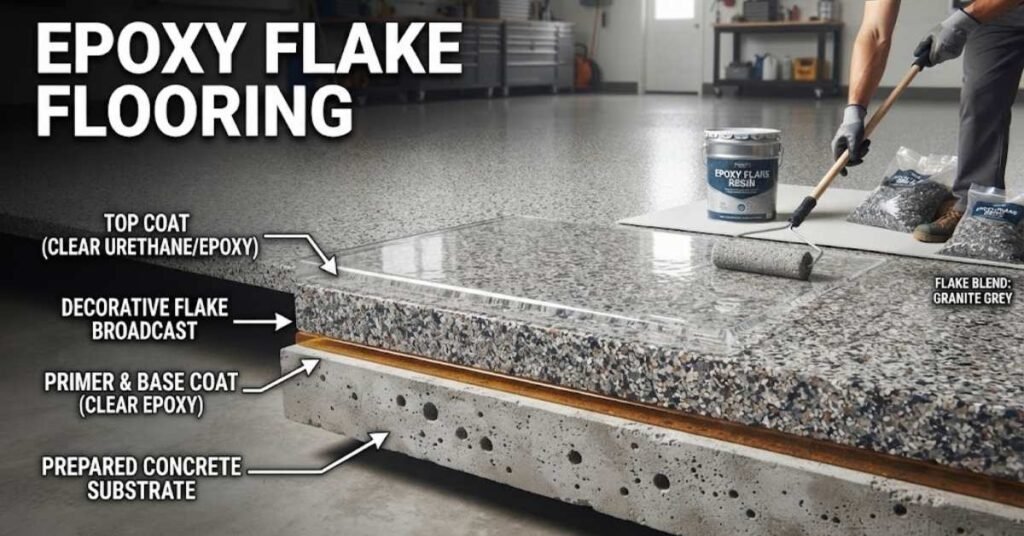
Epoxy flake flooring uses vinyl flakes scattered over the base coat.
The result is a speckled flake finish that hides dirt and dust.
It’s the favorite for garages and basement floors.
Flakes also add a bit of natural traction.
Quartz Filled Epoxy
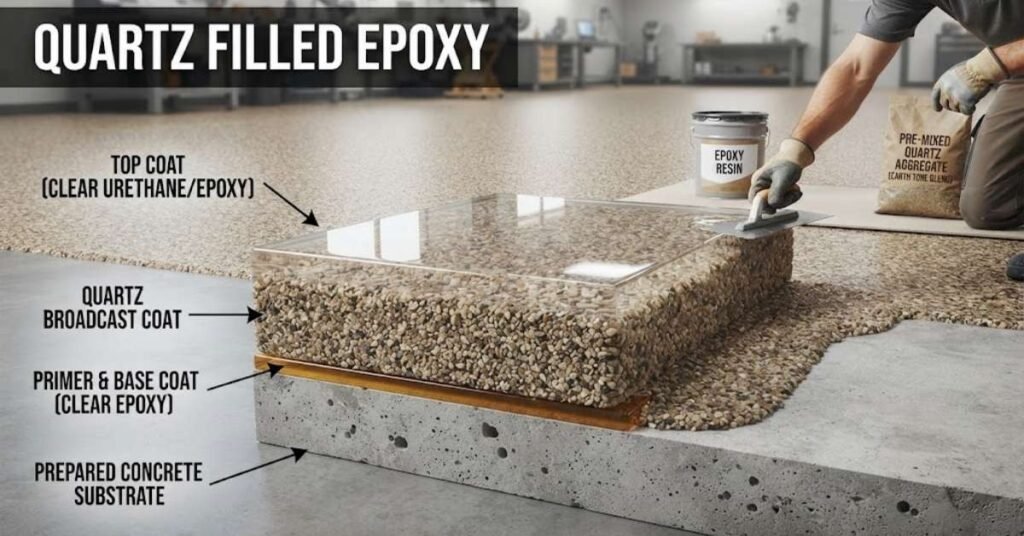
Quartz-filled epoxy blends colored sand into the resin.
You get a gritty, quartz finish with strong slip resistance.
It works well in kitchens, wet zones and ramps.
It’s tougher than flakes, but it costs more too.
Metallic Epoxy
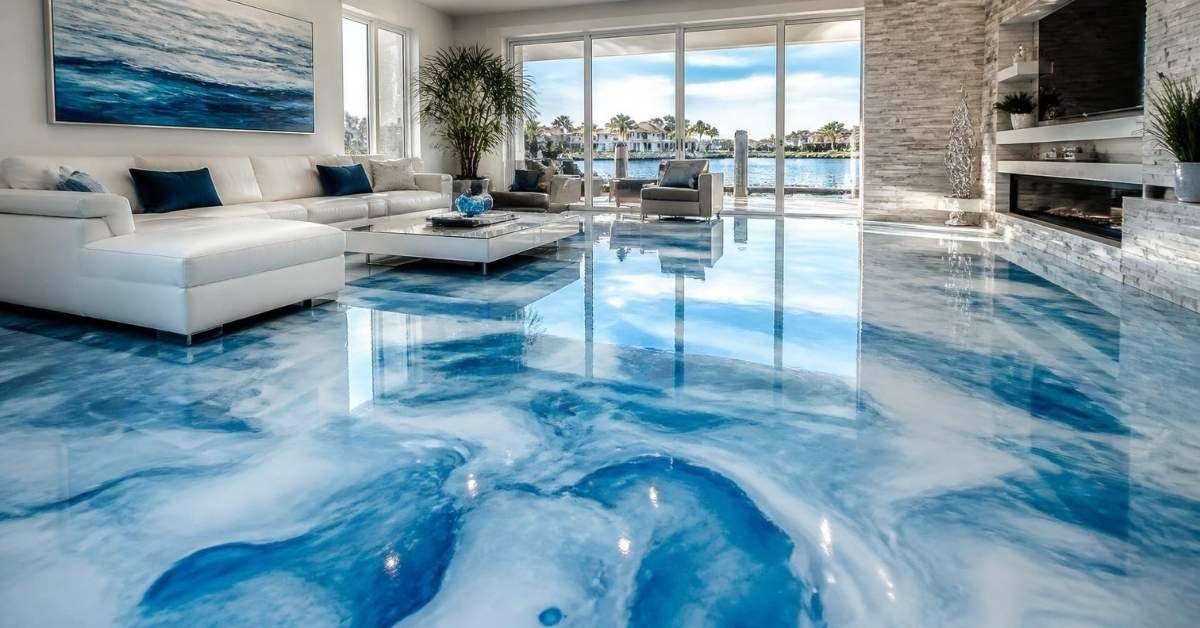
Metallic epoxy uses metallic pigments to swirl color like lava or marble.
No two floors look alike.
It’s a showpiece for lobbies, salons and living spaces.
It needs a skilled installer, so don’t expect a DIY shortcut.
Epoxy Mortar Flooring
Epoxy mortar mixes resin with dry sand into a thick, trowel-applied layer.
It’s a heavy-duty flooring choice.
Use it in loading areas and factories where forklift traffic pounds the floor.
It can also patch damaged concrete before another system goes on.
Epoxy Screed
Epoxy screed is similar to mortar, but it’s usually leveled as a flowing, thicker bed.
It repairs uneven floors and builds a strong base.
Industrial sites use it a lot.
You rarely need it at home.
Antistatic Epoxy
Antistatic epoxy carries static charge safely away.
That protects sensitive gear and avoids sparks.
You’ll see it in electronics manufacturing, data rooms and clean rooms.
Regular epoxy can’t do that job.
Epoxy Aggregate Or Gravelled Flooring
Epoxy aggregate flooring, also called gravelled flooring, binds small stones in resin.
It’s rugged and naturally textured.
Walkways, patios and entrances love it.
It looks great, but it’s harder to clean than smooth floors.
Epoxy Terrazzo Flooring
Epoxy terrazzo uses marble chips set in resin and polished smooth.
It gives a classic terrazzo finish with modern strength.
Museums, malls and airports use it often.
It’s a premium option, and the price shows it.
Epoxy Floor Finishes And Design Options
Looks matter, even in a garage.
A good decorative finish can turn a plain slab into the best-looking room in the house.
Matte, Satin, And Glossy Finishes
A gloss finish looks wet and bright, but it shows scratches and gets slick.
A matte finish hides marks and feels safer underfoot.
A satin finish sits in the middle.
Most homeowners end up happiest there.
Colored And Decorative Epoxy Resin Flooring
You can choose a solid color finish, a flake blend or a marble-like finish.
Light colors brighten dark garages, while darker tones hide dust less than you’d think.
Ask for a sample board in your own lighting.
Colors look very different under shop lights and sunlight.
Anti-Slip Texture Options
Smooth epoxy and water don’t mix.
An anti-slip texture fixes that.
Mix in a grit additive or add quartz in the final coat.
Your goal is better traction without a floor that’s impossible to mop.
Epoxy Floor Coating Vs Paint Vs Full Resin Flooring
These three get confused all the time.
They aren’t the same product, and they don’t last the same time.
Here’s a quick breakdown:
| Option | Thickness | Best for | Typical life |
| Epoxy paint | Very thin | Light-use rooms | Short |
| Epoxy floor coating | Medium | Garages, shops | Moderate |
| Full resin flooring | Thick | Heavy traffic | Long |
100 Percent Solids Vs Water-Based Vs One-Part Coatings
100% solids epoxy has no solvent that evaporates, so what you roll on is what stays.
Water-based epoxy is thinner and easier to apply, but it wears faster.
One-part epoxy and epoxy-infused paint are really paint with a little epoxy added.
They’re cheap, and they perform that way.
When Epoxy Paint Is Enough
Use it in a utility room, laundry room or hobby room where traffic is light.
It’s a decent budget flooring choice.
Don’t expect it to survive hot tires.
Hot tires lift cheap coatings fast.
When Epoxy Floor Coating Is Better
Go with a proper coating for garages, workshop floors and mechanical rooms.
It handles oil stains and chemical spills much better.
Add flakes and a clear topcoat for extra wear protection.
That combo hits the sweet spot for most homes.
When Full Resin Flooring Is Needed
Pick a full resin flooring system for warehouses, food plants and production floors.
Thick layers resist impact resistance problems like dropped tools and pallets.
It costs more upfront.
It also saves you from repeat repairs.
Epoxy Flooring Benefits
People choose epoxy for a handful of solid reasons.
Let’s look at the ones that matter most.
Durability And Impact Resistance
Cured epoxy has strong abrasion resistance and wear resistance.
It handles foot traffic, rolling carts and parked cars with ease.
Good floor durability also means fewer repairs.
That’s real long-term value.
Chemical, Oil, And Stain Resistance
Spilled motor oil? Wipe it up.
Splashed cleaner? No problem.
That oil-resistant and stain-resistant flooring quality keeps bare concrete problems away.
Raw concrete soaks up every spill like a sponge.
Easy Cleaning And Hygiene
No grout lines and no seams mean nowhere for germs to hide.
That’s why you see hygienic flooring in hospitals and a commercial kitchen.
A broom and mop do most of the work.
That makes it a true easy-to-clean flooring choice.
Design Flexibility
Flakes, quartz, metallic swirls and logos are all possible.
You can match a brand or a mood.
That’s the charm of decorative epoxy.
It protects and impresses at once.
Advantages And Disadvantages Of Epoxy Flooring
No flooring is perfect, and epoxy is no exception.
Honest pros and cons help you choose with confidence.
Slippery When Wet
Smooth, glossy epoxy gets slick with water.
Add an anti-slip additive if the space sees puddles or kids.
UV Yellowing And Sun Exposure
Standard epoxy can fade, chalk or yellow in strong sun.
A UV stable topcoat such as polyaspartic or polyurethane reduces that risk.
Repair Challenges
Fixing a deep gouge isn’t like touching up paint.
Patches can show unless a pro blends them.
Moisture And Peeling Risk
Moisture is epoxy’s biggest enemy.
Moisture vapor pushing up through the slab can cause peeling and blistering.
Where Epoxy Resin Works Best?
Epoxy fits many places, but some suit it better than others.
Think about traffic, moisture and looks before you commit.
Epoxy Flooring For House
Epoxy works well in garages, laundry rooms and basement floors.
It’s an easy, residential flooring upgrade for spaces that take a beating.
Epoxy Garage Floors
Picture a homeowner who parks a wet SUV every winter evening.
Without protection, the garage floor stains, dusts and cracks.
A garage epoxy system with flakes stops that.
It also makes the space feel finished.
Epoxy Kitchen Floor
A kitchen floor in epoxy has no grout to scrub.
It’s seamless, warm-looking and simple to wipe down.
Choose a textured finish, though.
Greasy water on glossy epoxy is a hazard.
Commercial Flooring Epoxy
Cafes, retail flooring, showroom floors and clinics love it.
It looks sharp, cleans fast and handles constant high-traffic areas.
Industrial Epoxy Flooring
Factories and warehouses need thick, chemical-ready systems.
Industrial flooring often combines mortar, quartz and antistatic layers.
Flooring Epoxy Resin Cost
Money questions come first for most readers.
So here are straight numbers, with a reminder that prices change by region.
Estimated Price Range
For a typical US job, expect roughly these ranges per square foot:
| System | Estimated cost per square foot |
| Epoxy paint or thin coating | $2 to $5 |
| Flake or solid color system | $4 to $9 |
| Quartz or metallic | $8 to $16 |
| Mortar, screed or terrazzo | $10 to $25 or more |
Treat these as ballpark figures.
Get an installer quote before you plan a budget.
What Affects The Price?
Several things move the project cost up or down:
- Surface condition and repairs needed
- Size of the area
- Labor cost and local rates
- Material cost and brand
- Type of finish and topcoat
Cheap Epoxy Vs Professional Epoxy
DIY kits cost less, but they often use thin coatings and weak primers.
Professional installation adds grinding, repairs and stronger products.
A cheap job can peel in a season.
A good one can last a decade or more.
Long Term Value
Divide the price by the years you’ll use it.
A premium flooring system that lasts 12 years beats a cheap one you redo every two.
Epoxy Flooring Installation Process
Good installs follow a clear order.
Skipping steps is how problems start.
Surface Preparation
Crews use concrete grinding or shot blasting to open the pores and create a surface profile.
Acid etching is a weaker DIY option that often leaves uneven results.
They also remove dust, debris and oil contamination.
Clean concrete bonds. Dirty concrete doesn’t.
Garage Floor Preparation Checklist
Run through this list:
- Empty the garage
- Degreasing oil spots
- Grind the surface
- Crack repair and filling joints
- Vacuuming all the dust
- Let the slab fully dry
Moisture Testing
Don’t skip this one.
A plastic sheet test tapes plastic to the slab for 24 hours to catch moisture.
Pros also use moisture content meters and calcium chloride tests.
If readings run high, use a moisture barrier primer.
Mixing And Application
Follow the resin-to-hardener ratio on the datasheet, exactly.
Watch the pot life, because mixed epoxy hardens fast.
Crews spread it with a squeegee, then back rolling with a roller for even coverage.
Then they add flakes or quartz while it’s wet.
Temperature, Humidity, And Ventilation
Most epoxies like moderate temperature and low humidity.
Too cold, and the cure drags. Too humid, and you risk a cloudy finish.
Good ventilation also controls odor.
Open doors and use fans.
Curing Time
Foot traffic is often okay after 24 hours.
Heavy vehicles usually need 5 to 7 days.
Check the cure time on your product.
Impatience ruins fresh floors.
Safety During Installation
Wear gloves, eye protection and a respirator.
Proper safety equipment keeps fumes and skin contact away.
Why Epoxy Floors Fail
Most failures trace back to prep, moisture or rushing.
Rarely is the epoxy itself the villain.
Peeling And Delamination
Delamination and coating lift happen when bonding fails.
Oily, damp or unprofiled concrete is usually the culprit.
Bubbles And Pinholes
Pinholes and bubbles often come from outgassing.
Air escapes the concrete as the temperature rises while the coating cures.
Cracking
Epoxy follows the slab.
If the concrete moves, the coating cracks, so honor expansion joints.
Scratches And Wear Paths
Gravel under tires and dragged tools cause scratches.
Heavy vehicle traffic also wears visible lanes over time.
Failure Prevention Checklist
- Test moisture first
- Grind properly
- Use the right primer
- Respect cure time
- Pick a quality topcoat
Epoxy Flooring Thickness And Materials
Thickness decides how much punishment your floor can take.
But more isn’t always better.
How Thick Is Epoxy Flooring?
A thin coating is about 10 to 20 mils total.
A thick coating system can reach 1/8 inch or more.
Coating, Slurry, And Mortar Thickness Ranges
Approximate ranges:
- Coating: 10 to 30 mils
- Slurry system: about 1/16 to 1/8 inch
- Mortar system: 1/4 inch or more
- Screed system: 1/4 to 3/8 inch
Best Thickness By Use Case
Homes and offices do well with a standard coating.
Warehouses and workshops need slurry or mortar.
Why Thicker Is Not Always Better
Thick layers can trap heat or crack if poorly mixed.
Matching the system to real use beats overbuilding.
Is Epoxy Flooring Waterproof And Durable?
Epoxy resists water, but that isn’t the same as stopping moisture from below.
Here’s the difference.
Water Resistance Vs Moisture Vapour
Spills sit on top and can’t soak in.
That’s good water resistance.
But moisture vapour rising from the slab can still push the coating off.
Real waterproof flooring needs a vapor-control step.
Durability In Homes
Home epoxy often lasts 10 to 15 years with decent care.
Light use and a good topcoat stretch that further.
Durability In Commercial And Industrial Areas
Heavy use cuts life, often to 5 to 10 years before recoating.
Strong systems, like mortar, last longer under hard traffic.
Epoxy Vs Other Flooring Options
Choosing between materials gets easier with direct comparisons.
Here’s how epoxy stacks up.
Epoxy Vs Tile Flooring
Tile flooring has grout lines that trap dirt.
Epoxy is seamless and easier to keep clean.
Epoxy Vs Concrete Floor
Plain concrete stains and dusts.
Concrete sealing with epoxy adds real concrete protection.
Epoxy Vs Polished Concrete
Polished concrete looks elegant and handles heat well.
Epoxy offers more color, though it can scratch more easily.
Epoxy Flooring Vs Polyurethane
Polyurethane flooring flexes better and resists UV.
Epoxy bonds harder and resists chemicals better, so many floors use both.
Resin Flooring Vs Epoxy Flooring
Resin flooring is the big family.
Epoxy is one member alongside MMA flooring, vinyl ester flooring and a hybrid resin system.
Garage Epoxy Vs Tiles
Garage tiles snap in quickly and hide cracks.
Epoxy gives a seamless look and seals the slab.
Epoxy Floor Maintenance
Epoxy is low maintenance, not no maintenance.
A simple cleaning routine goes a long way.
Daily And Weekly Cleaning
Sweeping or dust-mopping daily keeps grit off the surface.
Mop weekly with a pH-neutral cleaner.
What To Avoid
Skip harsh acids, steel wool and ammonia-heavy cleaners.
Don’t drag heavy gear across the floor either.
When To Recoat
Recoat when the gloss dulls or wear paths show.
Recoating early costs far less than full replacement.
When It Is Not The Best Choice
Epoxy isn’t for every space.
Honesty here saves you money.
Red Flags Before Installation
- Constant dampness in the slab
- Crumbling, weak concrete
- A floor that gets full midday sun
- Installers who skip prep
Better Alternatives In Some Spaces
Sun-baked patios may suit polyaspartic or tiles.
Cold, damp basements sometimes do better with vinyl flooring or tiles.
How To Choose The Best Epoxy Flooring Type
Start with space, traffic and budget.
Then match the system to that.
Final Buying Checklist
- Check the concrete condition
- Confirm moisture tests
- Review the traffic level
- Ask about chemical exposure
- Compare quotes and warranties
Best Option By Space
- Garage: flake with clear topcoat
- Kitchen: quartz or textured finish
- Showroom: self-leveling or metallic
- Warehouse: mortar or quartz system
Questions To Ask An Installer
Ask these before signing:
- How will you prep my slab?
- Which moisture test do you run?
- What’s the product’s solids content?
- How long is the warranty?
- Can I see past jobs?
Conclusion
Epoxy is a strong, good-looking floor when the prep and product are right. Test moisture, pick the right type and avoid cheap shortcuts.
Have you tried epoxy before? Drop your story or question in the comments, and share this guide with a friend planning a floor.
FAQs
What Is Epoxy Resin Flooring?
It’s a hard, seamless layer made from epoxy resin and hardener.
It bonds to concrete and protects it.
How Does Epoxy Flooring Work?
Primer bonds to the slab, then base coat, decorative layer and topcoat build the system.
Each layer cures into one solid surface.
How Long Does Epoxy Flooring Last?
Homes often see 10 to 15 years.
Commercial floors usually last 5 to 10 years before recoating.
How Much Does Epoxy Flooring Cost?
Most projects land between $2 and $25 per square foot.
System type and prep decide where yours falls.
What Are The Disadvantages Of Epoxy Flooring?
It can be slippery, yellow in the sun and tough to repair.
Moisture issues cause the worst failures.
Is Epoxy Flooring Good For Homes?
Yes, especially for garages, basements and laundry rooms.
Choose texture and a UV stable topcoat.
Which Epoxy Flooring Is Best For Home?
Flake systems with a clear topcoat suit most homeowners.
Quartz is better for wet areas.
Can Epoxy Flooring Crack?
Yes, if the concrete beneath it moves or cracks.
Proper joint treatment lowers the risk.
What Is The Difference Between Epoxy Floor Coating And Paint?
Coatings are thicker, stronger and more chemical resistant.
Paint is thin and wears faster.
Is Epoxy Better Than Tile Flooring?
For garages and workshops, usually yes.
For bathrooms and living rooms, tile may look better.
What Is The Best Epoxy Type For Heavy Traffic?
Epoxy mortar or quartz-filled systems handle heavy loads best.
Pair them with a durable topcoat.

Jack Danniel is a flower enthusiast, writer, and experienced SEO expert passionate about creating helpful content.
With years of experience in SEO and content strategy, he shares engaging and informative insights about flowers.
His goal is to make floral information easy to understand while helping readers discover the beauty of nature.